Why control always collapses to three modes
I used to think most conflict in organizations came from misaligned incentives or poor communication.
It doesn’t.
It comes from systems switching control modes without admitting it.
When pressure rises, systems stop debating ideas and start protecting themselves. What looks like personality friction is usually something colder and more mechanical: competing logics trying to decide which failure is unacceptable right now.
Once you see this, most “people problems” stop looking psychological and start looking structural.
Systems don’t optimize for ideals — they optimize against collapse
In calm conditions, systems talk about values, culture, and growth.
Under pressure, they revert to survival.
Not abstract survival — specific survival.
Every real system has a failure it cannot tolerate. When stakes rise, control shifts toward the logic designed to prevent that failure. The mistake most teams make is believing this shift is a debate.
It isn’t.
It’s a takeover.
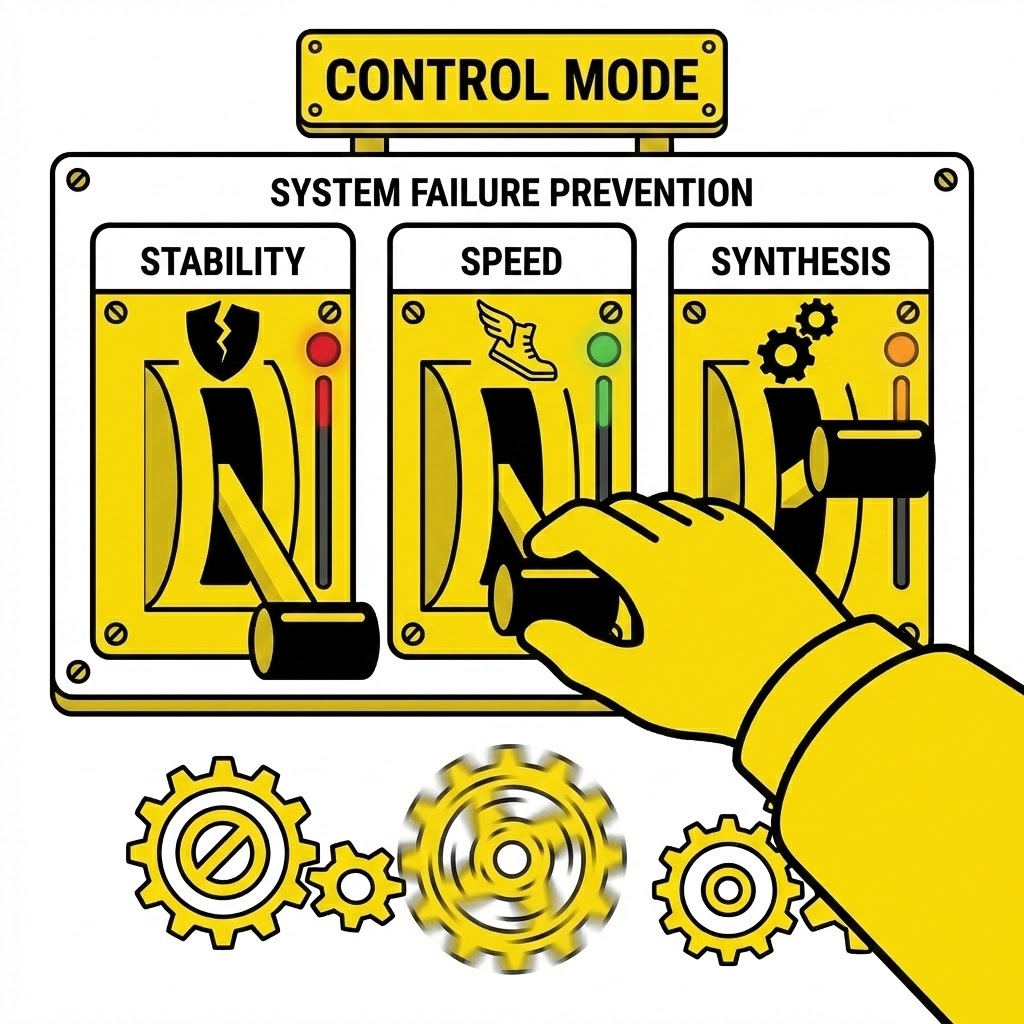
At the system level, only three control modes ever meaningfully compete.
Stability control: preventing breakage
Stability logic treats the system as fragile.
When it takes control, the system tightens:
- definitions harden,
- change slows,
- exceptions disappear,
- risk becomes the dominant lens.
From the inside, this feels responsible. From the outside, it looks obstructive.
The core assumption of stability logic is simple and often correct:
Undefined systems fail under stress.
This is why stability-driven control excels in environments where failure is irreversible — compliance, finance, safety-critical infrastructure, late-stage scale.
Where it goes wrong is timing.
If stability dominates before the system has learned enough, it doesn’t create safety. It creates brittleness. I’ve watched teams lock processes early, call it rigor, and then quietly suffocate momentum while congratulating themselves on discipline.
Stability is not the enemy.
Premature stability is.
Speed control: preventing stagnation
Speed logic treats the system as perishable.
When it takes control, the system moves:
- decisions bias toward action,
- constraints loosen,
- errors are tolerated,
- momentum becomes the proxy for truth.
Speed logic assumes:
Motion produces information faster than analysis.
In environments where timing matters more than precision — early-stage creation, market entry, sales — this is not reckless. It’s rational.
Speed creates learning. Stillness kills opportunity.
Where speed control fails is containment.
Left unchecked, it erodes its own foundations. What starts as agility becomes inconsistency. What starts as exploration becomes thrash. I’ve seen teams confuse velocity with progress and wake up months later unable to explain what they’ve actually built.
Speed isn’t chaos.
Unbounded speed is.
Synthesis control: preventing drift
Synthesis logic doesn’t feel intuitive, and it rarely feels good.
It treats the system as directionally unstable — not fragile, not perishable, but prone to drift.
When synthesis takes control, the system does uncomfortable things:
- it forces decisions,
- it sequences work,
- it assigns ownership,
- it closes loops that could stay open forever.
Its core assumption is this:
Systems don’t fail because people disagree.
They fail because no one is allowed to decide which concern temporarily loses.
Synthesis doesn’t generate ideas like speed.
It doesn’t create safety like stability.
It decides what survives.
This is why synthesis is so often misread as bureaucracy or coldness. It doesn’t soothe anxiety; it reallocates it. Someone always leaves a synthesis moment dissatisfied.
That dissatisfaction is the cost of coherence.
Why only one control mode can lead
These three logics are mutually exclusive at the point of control.
You cannot:
- explore freely and lock tightly,
- move fast and finalize decisions,
- optimize for safety and momentum simultaneously.
So systems must choose.
The real failure is not choosing — it’s choosing implicitly.
When no control mode is named, the loudest or most anxious one wins by default. That’s when systems oscillate, stall, or implode without understanding why.
The supporting patterns aren’t in charge
Other thinking patterns matter — but they don’t control systems.
Vision gives direction.
Risk defines boundaries.
Efficiency refines mechanisms.
Cohesion maintains trust.
Signal chases legitimacy.
All of them influence decisions.
None of them answer the question:
“What do we do next?”
Only stability, speed, or synthesis do.
Confusing influence with control is how organizations end up with endless discussion and no closure.
Most failures are dominance failures
What gets labeled as “execution issues” is often something simpler and harsher:
The wrong control mode dominated for too long.
- Stability too early → paralysis
- Speed too long → chaos
- Synthesis never asserting → drift
Healthy systems rotate dominance:
- speed during exploration,
- stability during consolidation,
- synthesis at closure.
This rotation does not happen naturally.
It has to be forced.
The uncomfortable truth about power
Power is not about being right.
It’s about:
- knowing which control mode is active,
- knowing which one should be active,
- and taking responsibility for the switch.
Most people argue content.
Effective operators govern control logic.
That’s why some people feel “blocking,” others feel “reckless,” and others feel “cold.” They’re not broken. They’re enforcing different failure boundaries.
Final question
When pressure rises in your system, what failure are you implicitly trying to prevent?
Breakage?
Stagnation?
Or drift?
Until that is explicit, your system isn’t debating —
it’s malfunctioning.
And no amount of alignment workshops will fix a control problem.