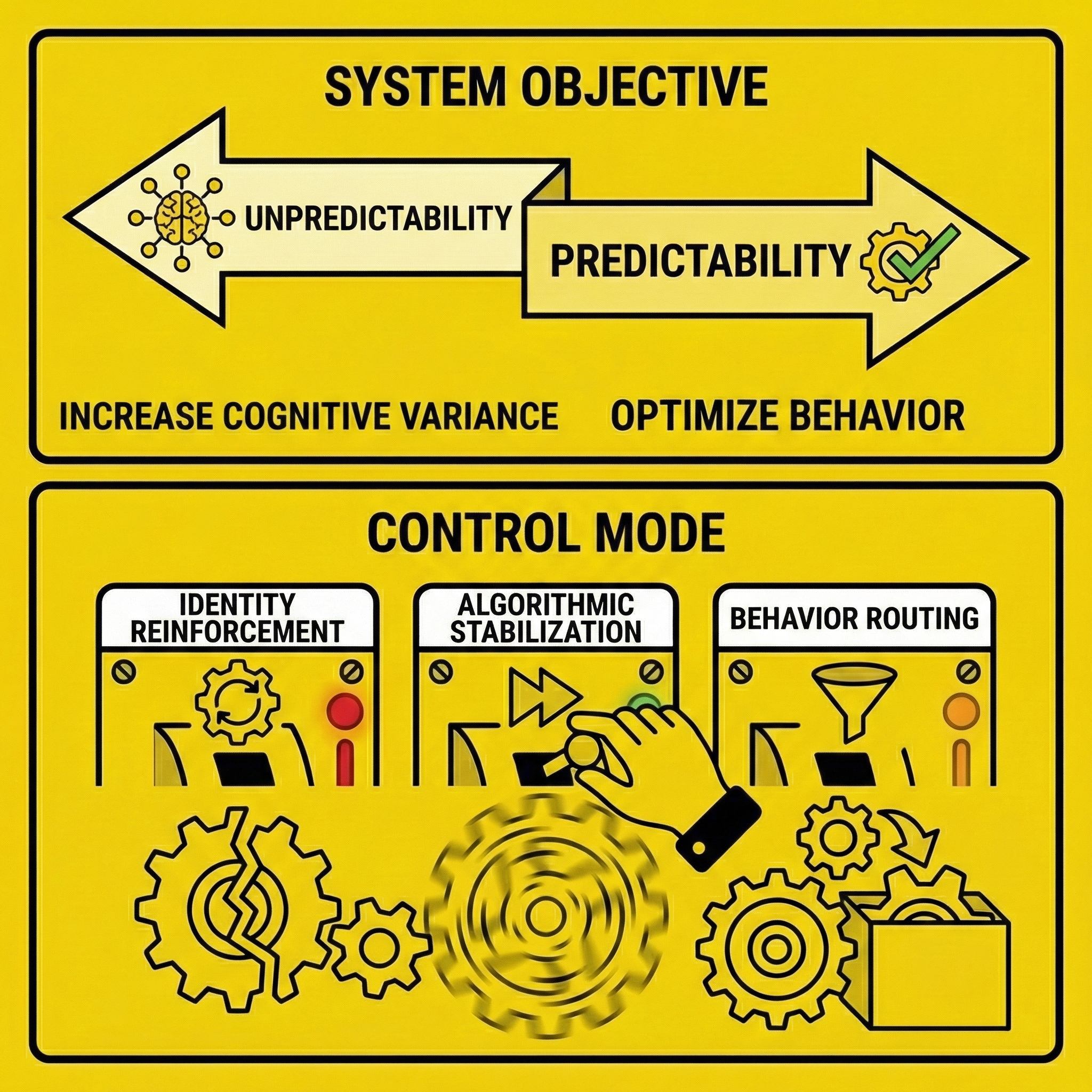
Why Modern Systems Optimize for Control, Not Understanding
There is a common belief that the internet decentralized power and democratized intelligence.
Technically, that’s true.
Structurally, it’s false.
What actually happened is more precise — and more consequential.
The network layer decentralized.
The attention layer collapsed.
Today, most people don’t experience the internet as an open system.
They experience it through a handful of platforms.
Five feeds.
Endless scroll.
Centralized distribution.
Control Is Always About Reducing Variance
At scale, every system faces the same constraint:
Variance is expensive.
Variance shows up as:
- independent thinking
- cross-domain reasoning
- delayed reactions
- people changing their minds
From inside a system, variance looks like risk.
So systems don’t suppress intelligence directly.
They reframe it into something cheaper to manage.
Broadcast Media Solved Alignment — Not Understanding
Mass media was the first large-scale solution.
It didn’t need people to be smart.
It needed them to be aligned.
Few senders.
Many receivers.
One-directional flow.
Truth was secondary.
Distribution was everything.
As long as enough people saw the same thing at the same time, the system held.
But broadcast media had a limit.
It created passive audiences in a world that was becoming active and complex.
Algorithms Didn’t Arrive to Inform — They Arrived to Stabilize
Social platforms solved a harder problem:
How do you coordinate billions of active agents without central command?
The answer wasn’t persuasion.
It was prediction.
Algorithms don’t care what you believe.
They care how reliably you behave.
They optimize for:
- emotional legibility
- pattern repetition
- identity consistency
- engagement predictability
Not because it’s malicious —
but because predictable agents are cheaper to coordinate than intelligent ones.
The Internet Became a Mass Distribution Infrastructure
The internet could have remained a distributed intelligence layer.
Instead, it evolved into a mass behavior routing system.
Choice still exists — technically.
But discovery is mediated.
Navigation is outsourced.
Most people no longer browse.
They are delivered.
Visibility, not access, became the bottleneck.
And whoever controls visibility controls behavior.
Five Platforms, One Control Logic
It doesn’t matter which platform.
The pattern is identical:
- closed feedback loops
- relevance optimized for engagement
- identity reinforcement
- time-on-platform maximization
Different interfaces.
Same control system.
This is coordination by convenience, not force.
The box adapts to the user — and that’s the trap.
Intelligence Is Allowed — As Long As It Stays Boxed
The system doesn’t want people stupid in the traditional sense.
It wants them:
- narrow
- reactive
- legible
- locally optimized
Deep thinking inside a lane is fine.
Crossing lanes is costly.
Over time, intelligence isn’t removed.
It’s contained.
Why This Eventually Breaks
Highly optimized local realities don’t add up to global coherence.
That’s when you see:
- polarization without dialogue
- intelligent people unable to agree on basics
- organizations that appear stable but can’t move
This isn’t a failure of values.
It’s a failure of control logic mismatched to complexity.
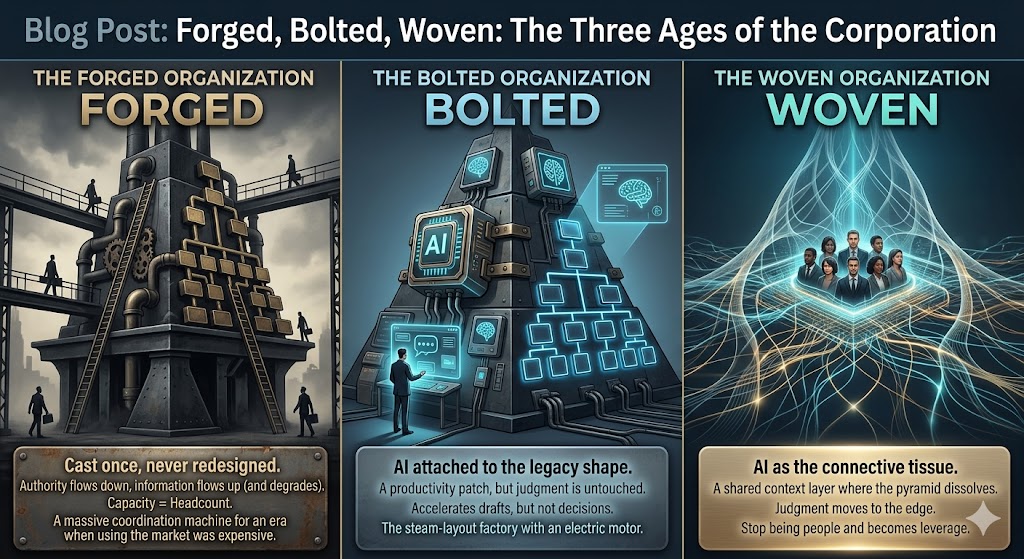
The Same Pattern Exists Inside Organizations
Under pressure, organizations don’t ask:
“What’s true?”
They ask:
“What failure is unacceptable right now?”
Speed, stability, and synthesis start competing — not as personalities, but as survival modes.
When leaders misread this, they blame people instead of correcting the system.
Escaping the Box Is a Systems Skill
You don’t escape by consuming “better content”.
You escape by increasing cognitive variance:
- crossing domains
- tolerating ambiguity
- slowing decisions
- engaging with models that don’t fit cleanly
Systems can handle smart individuals.
What they struggle with are people who are:
- hard to classify
- hard to predict
- hard to optimize
Those people introduce cost.
And cost is the one signal systems always respond to.
Final Thought
The internet didn’t fail as a technology.
It succeeded as an infrastructure for mass distribution.
What failed was the assumption that distribution automatically leads to intelligence.
It doesn’t.
It leads to whatever the control layer optimizes for.
Right now, that’s not understanding.
It’s predictability.