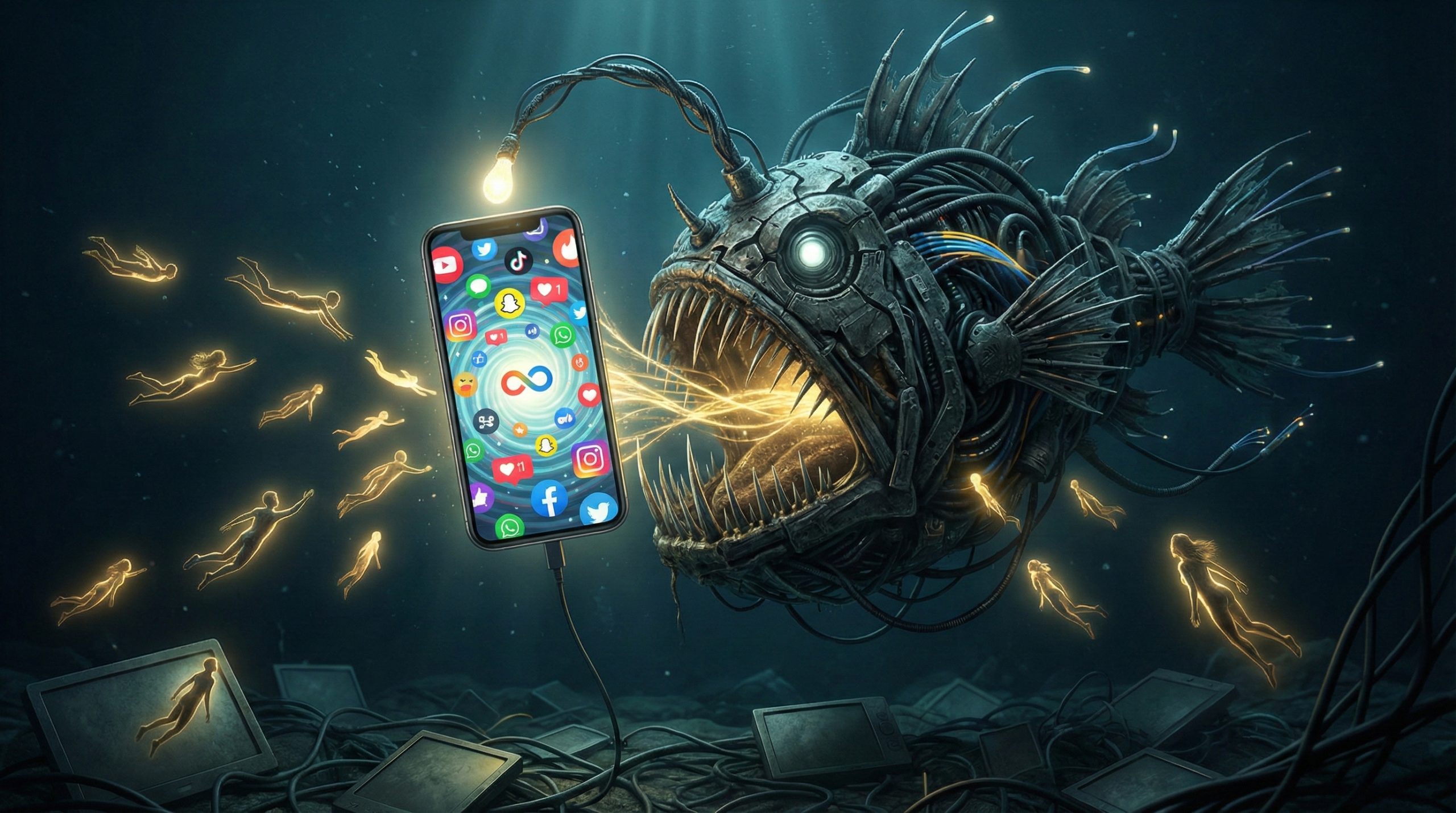
Predatorialism in the age of attention capture
Extraction has always followed the same logic.
Find a resource that is:
- Widely distributed
- Poorly defended
- Difficult to measure
- Taken incrementally
Then normalize its removal until resistance becomes impossible.
For most of history, that resource was land.
Then labor.
Then nature.
Then data.
Today, it is attention.
Why Distraction Is the Perfect Extraction Mechanism
Distraction does not look like force.
There are no contracts.
No coercion.
No visible harm.
That is its advantage.
Extraction succeeds best when the extracted believes they are choosing freely. Distraction creates precisely this condition. Every click feels voluntary. Every scroll feels earned. Every lost hour feels self-inflicted.
Responsibility is internalized.
Power remains external.
Predatorialism Without Predators
Traditional predation requires an identifiable predator.
The Distractconomy does not.
There is no single villain.
No central planner.
No mastermind.
Just incentives.
Systems optimized for engagement inevitably converge on distraction because distraction is the most efficient way to hold attention without resistance.
This is predatorialism without intent —
structural predation.
Extraction That Consumes Capacity, Not Output
Earlier extractive systems took what you produced.
This one takes what you could have produced.
Distraction does not steal labor.
It steals:
- Continuity
- Focus
- Memory
- Direction
It consumes capacity before it ever becomes output.
This is more efficient.
A distracted population does not organize.
Does not coordinate.
Does not sustain pressure.
It reacts.
Why This Is Upstream of Power
Power does not need obedience.
It needs incoherence.
A distracted population may be informed, expressive, and constantly active — yet remain strategically inert.
They know many things.
They feel strongly.
They act briefly.
Nothing compounds.
This is the ideal condition for extraction:
- Maximum activity
- Minimum leverage
The Illusion of Mutual Benefit
The most effective predatory systems do not appear exploitative.
They appear symbiotic.
Users receive:
- Entertainment
- Connection
- Stimulation
- Identity
In return, they give:
- Attention
- Emotion
- Cognitive availability
- Behavioral predictability
The exchange feels fair.
Until you examine who compounds power over time —
and who does not.
Why This Fits Predatorialism Exactly
Predatorialism is not about cruelty.
It is about asymmetry.
The Distractconomy creates asymmetry by:
- Extracting attention from the many
- Concentrating orientation among the few
Those who retain focus, time depth, and synthesis gain disproportionate advantage — quietly, legally, invisibly.
This is predation without spectacle.
Distraction as a Control Surface
Distraction does not suppress opposition.
It dissolves it.
It fragments movements.
It resets outrage.
It replaces strategy with stimulation.
Every system that profits from distraction benefits from a population that cannot hold a line — cognitively or politically.
This is not conspiracy.
It is compatibility.
The Endgame of Unchecked Extraction
Every extractive regime eventually hits a limit.
For attention, that limit is cognitive exhaustion.
When:
- Stimulation no longer stimulates
- Outrage no longer mobilizes
- Novelty no longer registers
The system must escalate — or collapse.
AI-mediated delegation is the escalation.
Orientation control is the prize.
Closing Thought
Distraction is not cultural decay.
It is economic logic.
It is extraction redesigned for an era where overt force is inefficient and consent is cheaper.
Predatorialism in the 21st century does not look like domination.
It looks like entertainment.
It looks like choice.
It looks like noise.
Until the pattern is seen.
Once seen, distraction can no longer be dismissed as a personal failure.
It is what extraction looks like
when it learns how the mind works.