Europe keeps trying to solve platform power by rebuilding platforms.
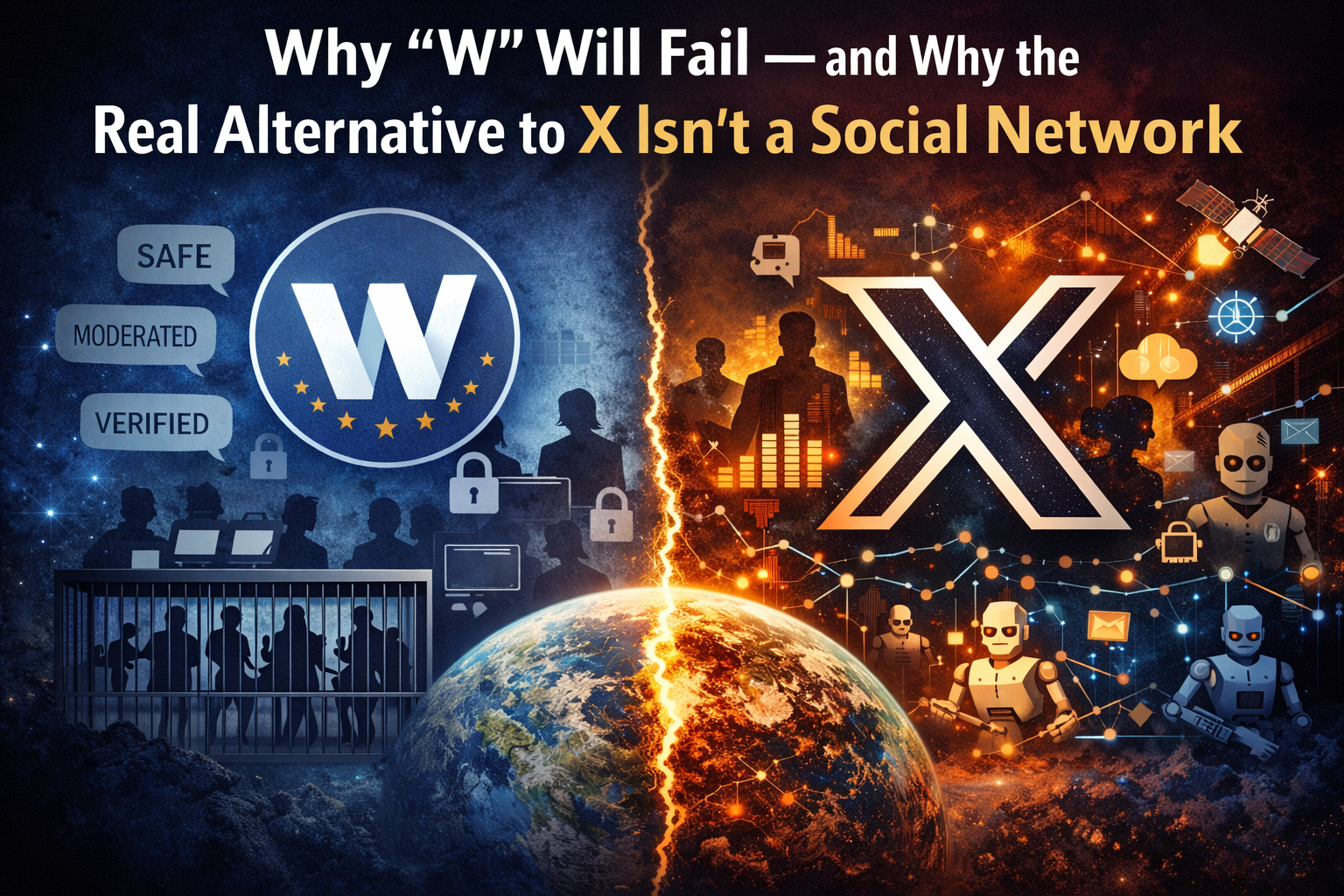
“W” is the latest attempt. Introduced during World Economic Forum week in Davos, led by CEO Anna Zeiter, W is being framed as a European answer to X: built, governed, and hosted in Europe, emphasizing human verification, data privacy, and free speech.
It sounds like competition.
It isn’t.
Because W is not misunderstanding X’s ethics.
It is misunderstanding X’s function.
And that makes failure inevitable.
1. X Is Not a Social Network — It’s a Coordination Engine
Calling X a social network is a category error.
X is a real-time coordination layer used by people who move systems:
journalists shaping narratives, politicians testing signals, founders recruiting attention, traders front-running stories — and increasingly, autonomous agents amplifying and arbitraging discourse.
People do not use X to connect.
They use it to coordinate under uncertainty.
W, by contrast, is building a place to post — cleaner, safer, more verified.
That difference alone decides the outcome.
2. W Is Optimizing for Legitimacy, Not Coordination
W’s own branding tells the story.
The name is explained as “We,” while the overlapping Vs in the logo stand for “Values” and “Verified.” The platform emphasizes identity verification (often described publicly as photo or identity validation), positioning itself as a response to bots, impersonation, and disinformation.
This is not accidental.
It is a thesis.
W is optimizing for:
- legitimacy,
- integrity,
- accountability,
- and institutional trust.
Those are virtues.
They are also constraints.
Coordination systems do not win by being legitimate.
They win by being useful to power.
3. Europe Keeps Confusing Civic Hygiene With Competitive Advantage
European platform thinking follows a recurring pattern:
if discourse is broken, improve the rules;
if trust is eroded, verify identities;
if harm exists, moderate harder.
W follows this logic faithfully.
But civic hygiene is not how coordination emerges.
It is how coordination gets sanitized after the fact.
The actors who matter most — agenda setters, signal amplifiers, narrative arbitrageurs — do not choose platforms because they are well governed.
They choose platforms because signals travel fastest there.
X tolerates volatility because volatility is how coordination happens.
W treats volatility as something to be engineered away.
In doing so, it removes the very forces that generate relevance.
4. Network Effects Are Directional — and Already Locked In
Network effects are not about how many people join.
They are about who arrives first.
X already hosts:
- journalists who break stories,
- politicians who test messaging,
- founders who convert attention into leverage,
- markets and machines reacting in real time.
Once that coordination class is embedded, everyone else follows out of necessity, not preference.
W is entering a field where the strategic terrain has already been claimed.
No amount of European hosting, verification, or values alignment changes that.
5. Regulation Is Not a Moat — It’s Latency
W emphasizes European governance, data protection, and regulatory alignment.
This is meant to signal trust.
In practice, it signals delay.
X moves at narrative speed.
W moves at compliance speed.
In an environment shaped by automated amplification, agent-driven media, and real-time geopolitical signaling, latency compounds brutally.
Platforms that hesitate do not lose debates.
They lose relevance.
W is being born slow.
6. The “European Alternative” Is a False Frame
The failure of W is not a failure of European talent or engineering.
It is a failure of framing.
The question was never:
“Can Europe build an alternative to X?”
The real question is:
“Does Europe understand what X has become?”
So far, the answer appears to be no.
7. What a Real Alternative Would Actually Look Like
If an alternative exists, it will not look like W.
And it will not look like a social network at all.
The only viable successor to X is post-platform coordination.
That means:
Signals, not posts
Reputation-backed statements.
Stake-weighted claims.
Time-decaying credibility.
Less expression.
More consequence.
Portable audiences
You own your graph.
You export your followers.
Attention is permissioned, not captured.
Agent-native architecture
Humans, bots, and LLMs participate as first-class actors.
APIs before UI.
Protocols before products.
Economic moderation, not moral moderation
No content police.
No values committees.
Instead:
- throttling,
- reputation decay,
- economic friction,
- silence by irrelevance.
Bad actors aren’t banned.
They’re ignored by the system.
Conclusion: W Is a Moral Response to a Strategic Problem
W is not failing because it is European.
It is failing because it is answering the wrong question.
X is not winning because it is American.
It is winning because it is useful to coordination under pressure.
There is no alternative to X as a social network.
The only alternative is what comes after platforms — a coordination layer where signals, agents, and reputation move faster than narratives ever could.
Until Europe confronts that reality, it will keep building nicer cages — and calling them alternatives.