Why the Object Doesn’t Matter — And Why That’s the Point
There is a toy that broke global retail.
It is ugly by design. A small, fanged, vaguely sinister creature made by a Chinese company called Pop Mart. It comes in blind boxes — you don’t know which version you’re getting. It retails for roughly twenty dollars. It resells for two hundred.
It is called Labubu.
And it has nothing to do with toys.
The object is a vessel.
This is the first thing to understand.
Labubu doesn’t work because people love the character. It works because the structure around the object manufactures desire at scale — blind box randomness, artificial scarcity, secondary market premiums, influencer proximity signals — and the object itself is almost incidental.
You could run the same mechanic with a keychain. A sticker. A $300 watch with a prestigious logo on it.
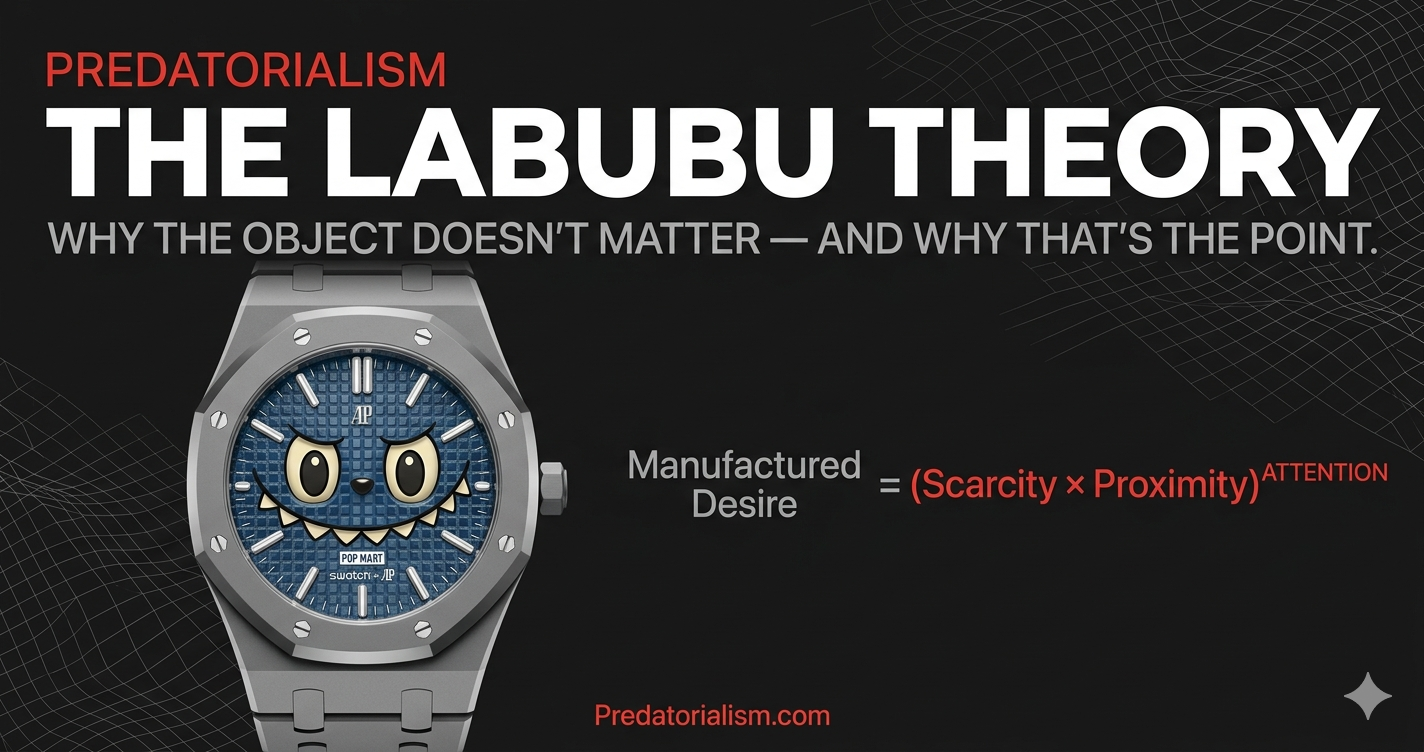
Which is exactly what Swatch just did.
AP x Swatch. Dubai. Amsterdam. Japan. Same morning. Thousands queuing. Events cancelled for public safety. Drops relocated. All of it filmed. All of it posted.
Labubu 2.0.
Different object. Identical architecture.
Here is the mechanic, precisely.
Step one: manufacture an object with borrowed cultural weight. Labubu borrows from streetwear drop culture and blind box collectible culture simultaneously. AP x Swatch borrows from one of the most inaccessible luxury brands in the world — a brand whose entry point is twenty thousand dollars — and attaches that weight to a three hundred dollar piece of bioceramic.
The object doesn’t need intrinsic value. It needs proximity to value that already exists elsewhere.
Step two: constrain supply below demand. Not slightly below. Dramatically below. The queue isn’t a distribution failure. The queue is the product. The chaos is the campaign. Every cancelled event is a content beat that costs nothing and reaches millions.
Step three: introduce the secondary market. The moment resale premiums emerge, the object transforms. It stops being a consumer product and becomes a financial instrument. Now you have two distinct populations in the queue — those who want to own the object and those who want to extract from others who want to own it. The flippers aren’t parasites on the system. They are load-bearing pillars. They deepen scarcity, amplify perceived value, and generate the price signals that make the next drop more anticipated than the last.
Step four: repeat. The mechanic is self-reinforcing. Each iteration trains a larger population to queue, to desire, to flip, to post. The brand invests almost nothing in traditional advertising. The crowd is the media.
Why a watch specifically.
Because the watch was never about telling time.
Luxury watches are one of the oldest optionality signals in existence — a physical object worn on the body that communicates access, taste, and net worth simultaneously. The AP Royal Oak is not a timekeeping device. It is a class marker with a complication.
What AP x Swatch did was take that signal — twenty thousand dollars of it — and ask a question globally and simultaneously:
How many people will degrade themselves for proximity to this signal?
Not ownership. Proximity.
A $300 watch with an AP logo is not an AP watch. Everyone knows this. The person wearing it knows this. But in the attention economy, the signal of desire for the brand is almost as valuable as the brand itself — to the brand.
They didn’t sell access. They sold the performance of wanting access.
And the crowd performed beautifully.
This is the Ark Economy sorting mechanism made visible.
In my framework, the world is dividing into those who manufacture desire, those who distribute it, those who extract value from it — and those who simply feel it.
Pop Mart manufactures desire. Swatch manufactures desire. AP lends its logo to the manufacturing operation while maintaining pristine distance from it.
The flippers extract. They are rational actors operating inside a structure designed to be extracted from. They are not villains. They are readers.
The fans feel. They queue. They wait. They go home with nothing — or they pay the flipper’s premium and go home with a $300 watch that signals they wanted to be near something they cannot afford.
The brands receive attention, data, and cultural reinforcement — at zero marginal cost.
The Labubu theory, stated plainly:
The object is a pretext.
What is actually being sold is the structure of desire around the object. Scarcity, randomness, social proof, secondary market premiums, cancelled events — these are not features or bugs. They are the product.
And the product scales infinitely — because it runs on attention, and attention is the one resource that has not yet found its ceiling.
Labubu proved it with a twenty dollar toy.
AP x Swatch proved it with a watch.
The next iteration will use a different object entirely.
The mechanic will be identical.
The question worth asking — and sitting with — is this:
If the object doesn’t matter, and the desire is manufactured, and the crowd is the media, and the flippers are just faster readers of the same structure —
what exactly are you queuing for?
Not the watch. Not the toy.
You are queuing for the feeling of being close to something scarce.
And that feeling — manufactured, distributed, extracted from —
is the most profitable product ever built.
And if you think that ceiling has been reached —
consider what happens when someone puts these two together.
AP x SWATCH x POPMART
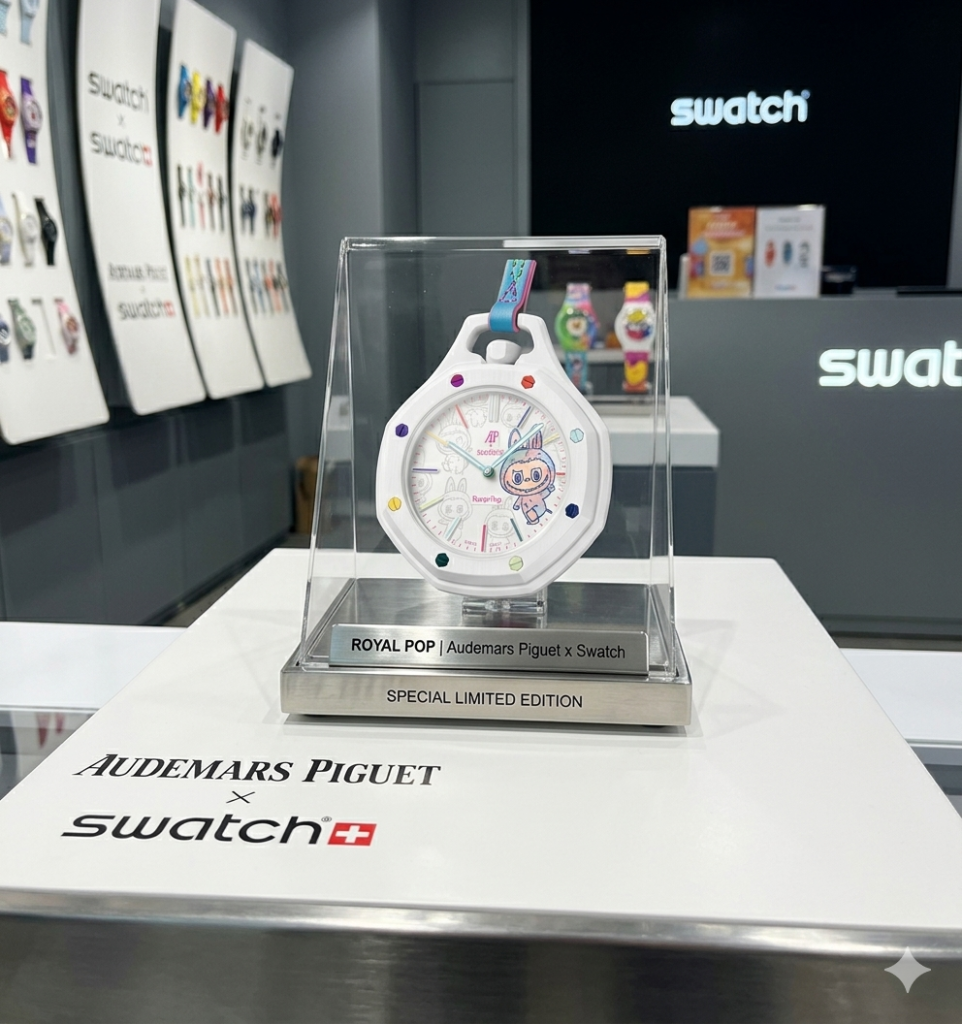
The next drop hasn’t happened yet.
But you already know you’d queue for it.