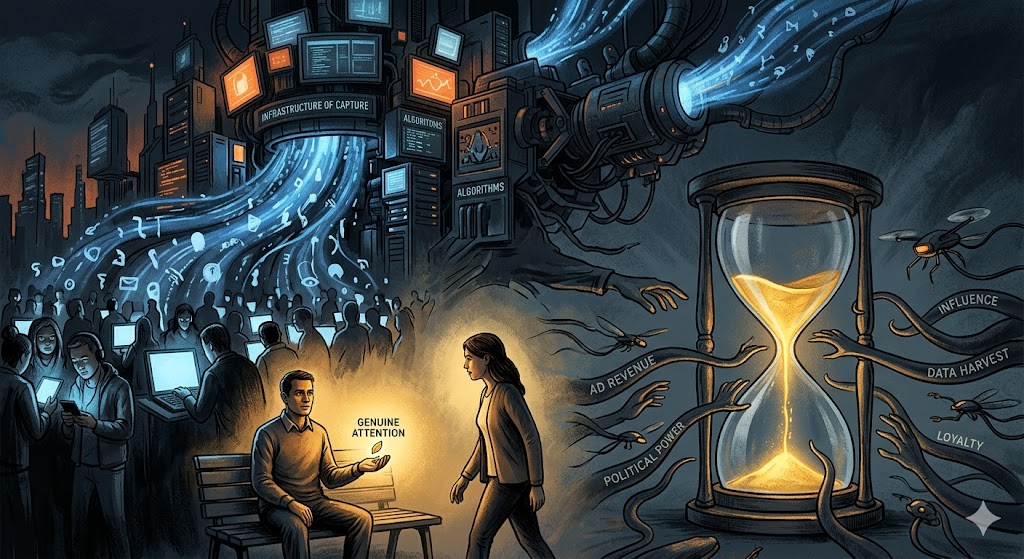
Attention is the only truly scarce resource of the 21st century. Not oil. Not data. Not even money. Everything else — power, influence, loyalty, love — flows toward whoever holds it. It always has. But now, for the first time in history, there is an entire industrial infrastructure built specifically to capture, harvest, and monetise it. And most of us are still pretending the product is something else.
We have been describing, across this todays series, a fifty-year process of subtraction. The removal of human contact from daily life. The systematic elimination of everything that could not be entered into a spreadsheet. The harvesting of the loneliness that remained. Each piece of this story is real. But we have been circling something without naming it directly. It is time to name it.
Everything we have described — the automation, the platforms, the grief, the AI — is not really about efficiency. It is not really about technology. It is about the oldest dynamic in human civilisation, now operating at a scale and precision that history has never seen before.
It is about attention. Who has it. Who wants it. Who is willing to pay almost anything to get it. And what happens to a society when capturing it becomes the primary business model of the age.
The Only Scarcity That Matters
Every era has its defining scarce resource. Land, in the agrarian world. Coal and iron in the industrial revolution. Oil through most of the twentieth century. Each era’s power structures formed around whoever controlled that resource — who owned it, who could extract it, who decided its price.
The scarce resource of our era is not data, though the platforms would like you to believe it is. Data is abundant, cheap, and increasingly worthless without the infrastructure to act on it. It is not intelligence, though the AI companies would like you to believe that too. Intelligence, in the narrow computational sense, is being commoditised faster than any resource in history.
The scarce resource is human attention. The finite, non-renewable, deeply personal capacity of a human being to notice something, to dwell on it, to care about it. There are only twenty-four hours in a day. There is only one of you. And there are ten thousand systems, all engineered with extraordinary sophistication, competing for every minute of your conscious life.
Attention is the only resource that cannot be manufactured, substituted, or scaled. Every other scarcity can be engineered around. This one cannot. Which is precisely why everything flows toward whoever controls it.
This is not a metaphor. It is an economic fact. Every major wealth creation story of the last twenty years is, at its foundation, a story about attention capture. The product — the video, the post, the search result, the feed — is the mechanism. The attention is the asset. And like all assets, it generates returns: advertising revenue, data, influence, political power, the ability to launch products and move markets with a single post.
The asset was always there. What changed is that we built machines capable of extracting it with industrial efficiency.
The Infrastructure of Capture
The platforms did not invent the desire for attention. They industrialised its harvest. And they did so by exploiting precisely the void that fifty years of transactional, automated, impersonal institutional life had created.
Consider the mechanism. Decades of self-service automation removed human presence from daily transactions. People became, by increments, attention-starved — deprived of the small but real moments of acknowledgment that structure a social life. The checkout operator who noticed you. The bank teller who remembered your name. The petrol attendant who was simply, plainly, there.
Into this deficit arrived platforms offering something that felt, powerfully, like human presence. Faces. Voices. Consistency. The parasocial warmth of someone who showed up every day, who seemed to know you, who spoke directly to camera as though addressing you personally. It was not real attention. It was the simulation of attention, optimised to trigger the same neurological responses as the real thing.
The loop this created is not one that tends toward equilibrium:
- Loneliness creates attention hunger.
- Attention hunger makes people easy to capture.
- Captured attention generates revenue.
- Revenue funds better capture technology.
- Better technology deepens the loneliness.
- Deeper loneliness increases attention hunger.
Each iteration extracts more, leaves less, and makes the next extraction easier. The loneliness economy and the attention economy are not separate phenomena. They are the same machine, viewed from different angles.
The Anatomy of an Attention Node
Look at every commanding cultural and economic figure of the last two decades through this lens and the pattern becomes impossible to ignore.
Elon Musk does not sell cars or rockets at the core. He sells the gravitational pull of his own presence. Products follow attention, not the reverse. The Kardashians built an empire with no original product — pure attention capture, monetised across beauty, fashion, media, and culture. MrBeast understood before almost anyone that attention at scale is a balance sheet asset; everything else — chocolate bars, restaurants, philanthropy — is downstream of it. Joe Rogan sold a conversation, then sold the audience of that conversation for $100 million. The product was never the podcast. It was the trust of the people listening.
The old economy said: build a great product, and customers will come. The attention economy inverts this entirely. Capture attention first. The product can be figured out later — or never. Because at sufficient scale, the attention itself is the product, and it can be sold in any direction the holder chooses.
This is the game. And most businesses, most entrepreneurs, most institutions are still playing the old one.
Why Authentic Attention Cannot Be Faked at Scale
Here is the critical tension, and within it, the entire opportunity of the coming decade.
AI can generate content infinitely. Text, images, video, voice — all of it, at zero marginal cost, at any quality level, on any subject, forever. The supply of content is now, for practical purposes, infinite. Which means content, as a category, is becoming worthless. Noise.
What AI cannot generate is the felt sense of a real person choosing to be present with you. Not performing presence. Not simulating it. Actually being there — with their specific history, their genuine stake in the outcome, their irreplaceable particularity as a human being.
This is not a sentimental observation. It is a market observation. People know the difference. Not always consciously, not always immediately — but over time, the hollowness of simulated attention becomes apparent. The parasocial relationship with the influencer satisfies for a while, then leaves a residue of emptiness. The AI therapist helps with the words but not the weight. The algorithm knows your preferences but does not know you.
AI can produce infinite content. It cannot produce the feeling of being truly seen by another person. That feeling — presence, particularity, the sense that someone is genuinely there — is now the rarest thing in the world.
Which means that as artificial attention floods every channel, the value of real attention — human, specific, genuinely given — does not fall. It rises. Sharply. The more noise there is, the more signal is worth. The more simulation there is, the more the real thing commands a premium.
We are at the beginning of the greatest scarcity premium in history for something that has always been free: a real person, actually paying attention to you.
The Business That Has Not Been Built
This is where the fifty years of subtraction, the loneliness economy, the tyranny of the measurable, and the attention economy all converge into a single, enormous, almost entirely unoccupied market position.
The platforms captured attention by simulating human presence. They built the machine to harvest the deficit. But the simulation has a ceiling — people feel the emptiness of it eventually, and the deficit deepens rather than resolves.
The business that has not been built is the one that delivers real attention at accessible scale. Not the ultra-luxury version that the wealthy already have — the private doctor, the personal banker, the dedicated advisor. Not the free automated version that everyone else gets. The version in between. Human. Present. Genuine. Priced for the middle, which is where almost everyone lives.
In healthcare. In education. In financial guidance. In legal access. In companionship and community. In every domain where the human has been removed and people are quietly, desperately aware of the absence.
The product in each case is the same: a real person, paying real attention, over time, with genuine stake in the outcome. The mechanism varies. The core proposition does not.
And crucially — the business that delivers this does not just fill a gap. It captures the most valuable thing in the modern economy. Because the people who feel genuinely attended to do not comparison shop. They do not churn. They do not leave for a cheaper option. They refer everyone they know. They become, in the truest sense, loyal — not because they were retained by a loyalty programme, but because someone was actually there for them.
Loyalty born from genuine attention is the only loyalty that compounds. Everything else is just retention masquerading as relationship.
The Synthesis
We started with a machine at a petrol station. We end here, at the centre of the defining economic and human question of the century.
Fifty years ago, institutions began removing humans from transactions in the name of efficiency. The costs of that removal — loneliness, disconnection, the erosion of trust — were externalised. Not counted. Not visible on any spreadsheet. So they accumulated, silently, until they became the condition of modern life.
The platforms arrived to harvest that condition. They built an industrial infrastructure for capturing the attention of the lonely, and called it connection. They made extraordinary fortunes. They made the condition worse.
Now AI arrives to complete the project — to remove the human from the final domains where presence still mattered. And it will succeed, in the way that all the previous removals succeeded: efficiently, profitably, and at enormous unmeasured cost to the people it processes.
Unless someone understands that the logic can be run in reverse. That the same scarcity that makes attention the defining resource of the age also makes the human who offers it genuinely — fully, consistently, with real stakes — the most valuable proposition in any market they enter. That the spreadsheet cannot see this does not mean it is not true. It means it is an arbitrage. A gap between what the system values and what people actually need.
The tyranny of the measurable created the loneliness. The loneliness created the attention hunger. The attention hunger is the market. And the market is waiting — desperately, quietly, with more purchasing power than anyone has yet tried to reach — for someone to show up.
Not a platform. Not an algorithm. Not a chatbot with a warm tone.
A person. Actually there. Actually paying attention.
That is the rarest thing in the world right now. And rare things, in markets, command whatever price the seller chooses to name.
The last scarce thing is a person who is present.
Published in Predatorialism · The Measurable Series, No. 3 · End of Series