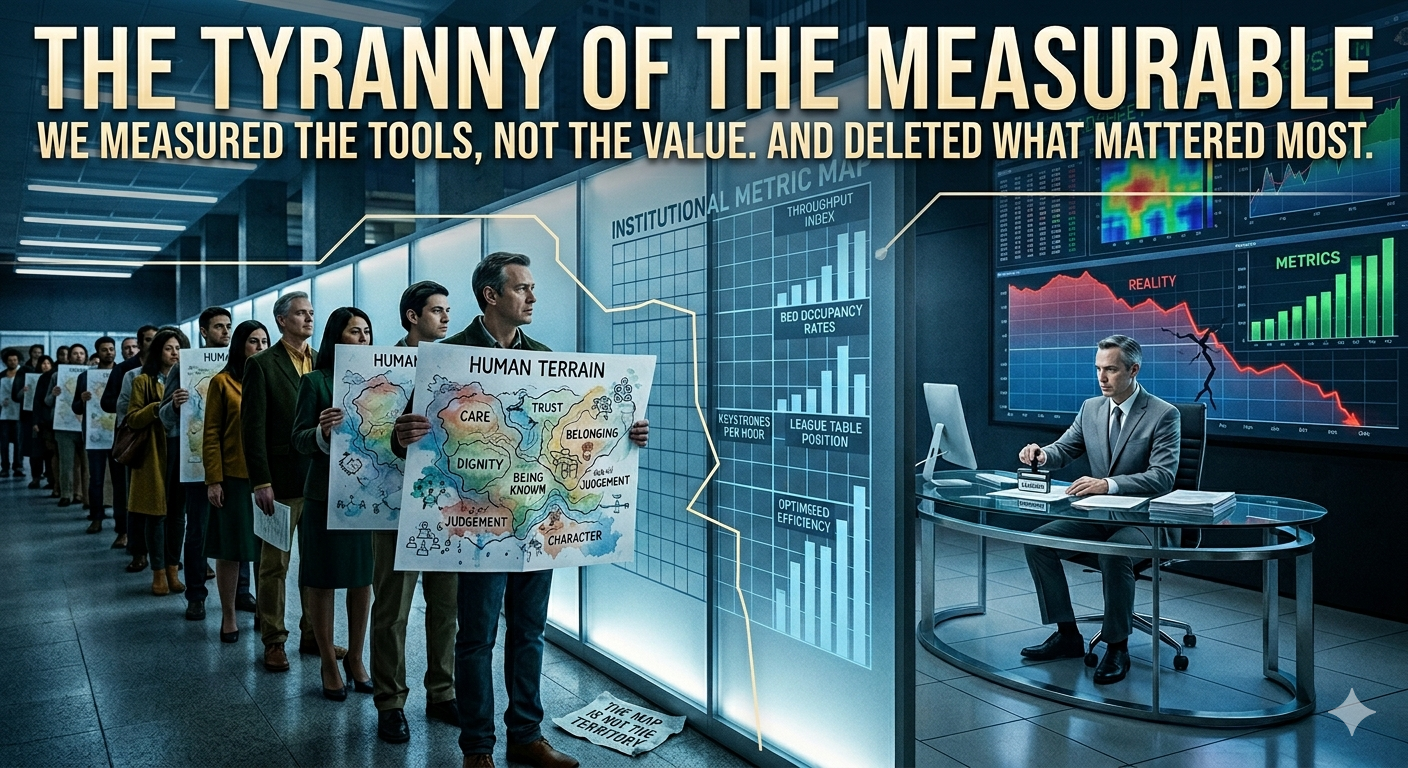
We built tools to measure value. Then we forgot that the tools were not the same as value itself. What followed was the quiet deletion of everything that mattered most — because it could not be counted.
There is a concept in economics called the streetlight effect. A drunk man loses his keys in a dark alley but searches for them under the streetlight — not because that is where he dropped them, but because that is where he can see. Modern institutions have been operating on this principle for fifty years, and the consequences are everywhere, hiding in plain sight.
We measure what we can. We optimise what we measure. We defund and dismantle what we cannot. And because the things most essential to a functioning human life — dignity, trust, belonging, care, the feeling of being known — resist quantification almost entirely, they have been steadily and systematically stripped from the institutions that were supposed to provide them.
This is not a conspiracy. It is something more pervasive and more difficult to resist: a logic. The logic of the spreadsheet. And it has become, without most of us noticing, the operating system of modern civilisation.
The Map Became the Territory
The tools themselves were not the problem. Measurement, accounting, quantification — these are genuinely useful. A hospital needs to know how many beds it has. A school needs to know whether children are learning to read. A business needs to know whether it is solvent. Numbers are not the enemy.
The error — quiet, incremental, and catastrophic — was the moment we began to treat the measurable as synonymous with the real. When a hospital starts optimising for bed occupancy rates rather than patient outcomes. When a school teaches to standardised tests rather than to curiosity. When a business measures employee productivity in keystrokes per hour and calls it a picture of human contribution.
The substitution follows a clear logic:
- What can be measured becomes what gets managed.
- What gets managed becomes what is considered real.
- What is considered real receives the resources.
- What cannot be measured disappears.
The philosopher Alfred Korzybski wrote that the map is not the territory. The measurement is not the thing being measured. But in institution after institution, across sector after sector, the map has quietly displaced the territory. The metric has become the mission. And when that happens, the organisation begins optimising for the wrong thing entirely — with tremendous efficiency.
When a metric becomes a target, it ceases to be a good metric. The organisation stops pursuing the goal and starts pursuing the number.
This is known as Goodhart’s Law, named after the British economist who observed it in monetary policy. It has since colonised almost every domain of institutional life. School league tables incentivise gaming the tests. Hospital waiting time targets incentivise treating easy cases first. Police crime statistics incentivise under-recording. In each case, the number improves while the reality it was supposed to represent quietly deteriorates.
The Economics of the Invisible
Economics has a formal term for what gets left out: externalities. The costs — or benefits — that do not appear on a balance sheet because they are borne by people or systems outside the transaction. A factory that pollutes a river is not paying for the river. A platform that harvests loneliness is not paying for the loneliness. A corporation that replaces its workforce with machines is not paying for the communities those jobs held together.
The costs are real. They are simply invisible to the system doing the accounting. And because they are invisible, they do not register as costs at all — until they become so large that they can no longer be ignored. Climate change is the most dramatic example: a century of externalised environmental costs, now arriving as a bill that the entire species must pay. But the same logic operates at every scale, in every sector, all the time.
Consider what was externalised when banks replaced tellers with ATMs. The direct saving was visible and immediate: labour costs, floor space, operating hours. What was not counted: the elderly customer who found the machine confusing and stopped engaging with her finances. The small business owner who lost a banker who knew his circumstances. The town whose high street declined when the branch closed. The subtle but real erosion of institutional trust that accumulates when people feel processed rather than served.
None of these appear in the bank’s quarterly results. All of them are real. The bank’s spreadsheet showed a gain. Society’s ledger — if anyone were keeping it — showed a loss. The difference between those two numbers is, in aggregate, the story of the last half century.
What Cannot Be Counted
Make a list of the things that make a human life genuinely good. Not comfortable — good. Meaningful. Worth the difficulty of living it.
The list will include: being known by someone. Feeling that your presence matters. Having work that connects you to something larger than yourself. Belonging to a community with shared stakes. Being treated, by institutions and by strangers, as a full person rather than a data point. Trust — in other people, in systems, in the future.
Now ask: how many of these appear in a GDP figure? In a productivity metric? In a customer satisfaction score? In an engagement rate? Almost none of them. They resist quantification not because they are vague or sentimental, but because they are genuinely complex — relational, contextual, cumulative, and deeply resistant to the kind of reduction that measurement requires. You cannot survey your way to a number that captures what it means to feel known. You cannot A/B test your way to trust.
The things most essential to human life are almost entirely unquantifiable. Which means they are almost entirely defenceless against a system that only protects what it can measure.
And so they go unprotected. Not through malice, but through the structural blindness of institutions that can only see what their instruments can detect. The checkout operator who remembered your name is gone — not because her warmth was valueless, but because her warmth did not appear on the labour cost line. The family doctor who knew your history for twenty years is gone — replaced by a rotating roster of practitioners optimised for throughput, because throughput is what the system could measure and therefore what it managed toward.
The Ratchet That Does Not Turn Back
There is a compounding quality to this process that makes it particularly difficult to reverse. Each round of optimisation removes people and replaces them with systems. Those systems then define what is normal. The generation that grows up with the systems does not experience the absence as a loss — they have no reference point for what was there before. And so the baseline quietly shifts, the expectations adjust, and what was once a degradation becomes, simply, how things are.
Children who have only ever interacted with automated customer service do not think to expect a human. Patients who have only ever been triaged by an algorithm do not know that a doctor once had the time to ask how you were sleeping. Workers who have only ever been evaluated by productivity software do not imagine a workplace in which judgement, character, and care were considered relevant to performance.
The ratchet turns one way. Each normalisation of the reduced state makes the next reduction easier to implement, harder to resist, and more difficult to even perceive as a loss.
The Deliberate and the Emergent
It is tempting to assign responsibility — to find the people who decided that measurable efficiency would trump unmeasurable humanity, and hold them accountable. But the truth is more unsettling. In most cases, no such decision was ever made. The outcome emerged from the aggregate of thousands of individually rational choices, each one defensible in isolation, collectively catastrophic.
A middle manager approves a self-checkout pilot because the numbers support it. A board accepts a restructuring plan because the modelling shows savings. A government adopts a productivity framework because it needs to demonstrate value for money. No individual in this chain is villainous. Each is operating rationally within a system whose metrics exclude what they cannot see.
But rationality within a broken system is not wisdom. It is compliance. And compliance with a system that systematically excludes human value from its calculations is, whatever its intentions, a form of participation in the damage.
Rationality within a broken system is not wisdom. It is compliance. And compliance, whatever its intentions, is participation.
Reclaiming the Uncountable
The answer is not to abandon measurement. It is to remember what measurement is for: to help us pursue things we actually value, not to replace our judgement about what is worth pursuing. A thermometer is useful. A civilisation that defines health as a particular temperature reading has confused the tool for the goal.
This requires something that optimisation culture finds almost intolerable: the willingness to protect things whose value cannot be demonstrated in advance. To say, as a matter of principle, that a doctor should have time to sit with a patient — not because a randomised trial proved it improves outcomes, but because it is the right way to treat a human being in distress. To say that a community deserves a bank branch, or a post office, or a school with small classes — not because the cost-benefit analysis supports it, but because the cost-benefit analysis is measuring the wrong things.
This is not sentimentality. It is a more rigorous relationship with reality than the spreadsheet allows. The spreadsheet captures what is easy to count. Reality contains everything else. A society that can only act on what appears in the spreadsheet is not being rational — it is being selectively blind, and calling the blindness efficiency.
The things that make life worth living are not on the balance sheet. They never were. The question is whether we are willing to protect them anyway — to insist that their absence from the ledger reflects a failure of accounting, not a failure of value.
We built the spreadsheet. We can decide what it is for. What we cannot do, indefinitely, is pretend that what it cannot see does not exist — and then wonder why everything that mattered seems to be disappearing.