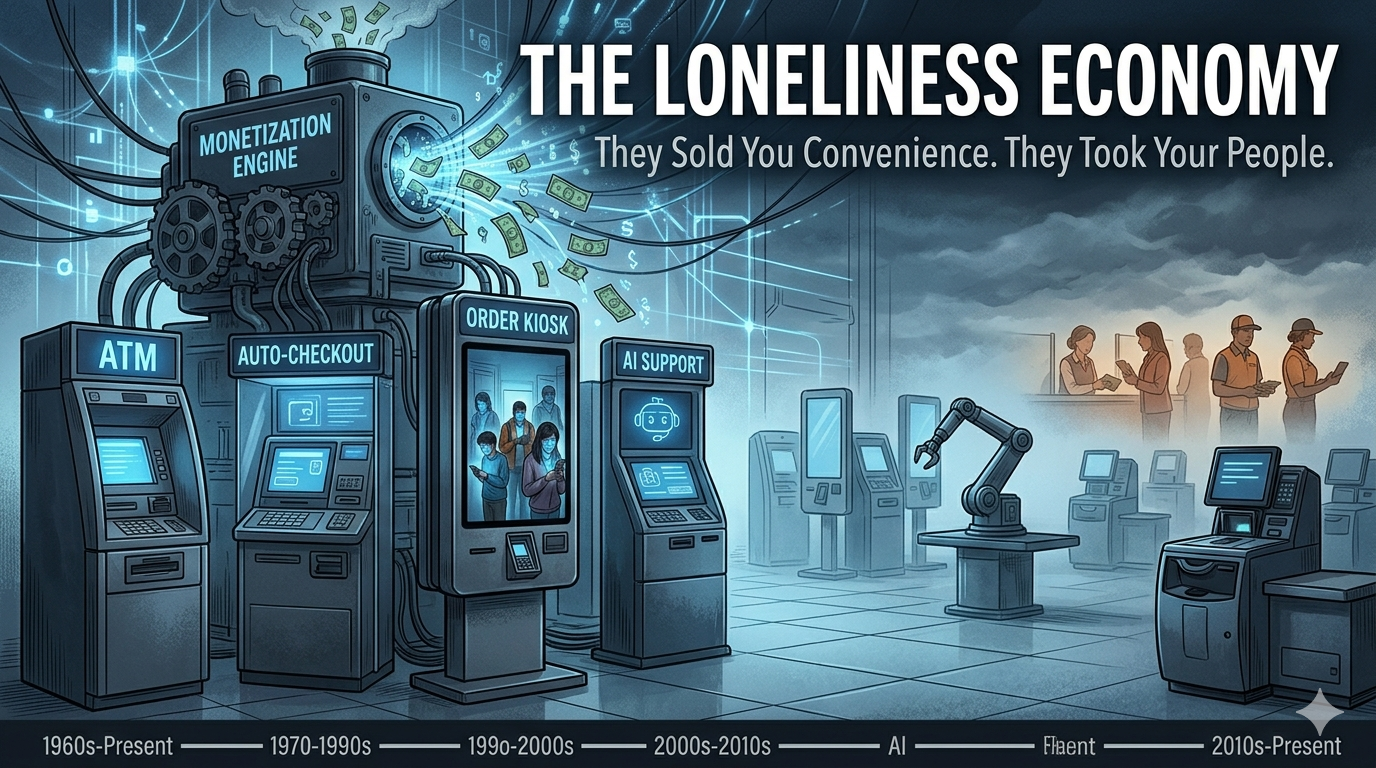
THE LONELINESS ECONOMY
The removal of human contact from everyday life was not an accident of progress. It was a business model. And the grief it produced was monetized before most of us noticed we were grieving.
It began, as so many dispossessions do, with something that felt like a gift. The ATM appeared in bank lobbies and on street corners and it was genuinely useful — money, any time, no queue. Nobody framed it as the beginning of the end of a certain kind of human exchange. It was just a machine. It was just convenient.
Then came the petrol station forecourt, where an attendant once filled your tank, took your money, perhaps said something about the weather. That person disappeared so gradually, across so many countries, that the disappearance barely registered. You learned to use the pump. You stopped expecting a face. New Jersey passed a law requiring attendants and was mocked for being quaint. Japan kept them, bowing as you leave the forecourt, and was admired as a curiosity. The rest of the world moved on.
The supermarket followed. Self-checkout arrived as an option, then became the default, then became the majority of lanes. The person who once scanned your shopping — who might have recognised you as a regular, who represented, however briefly, an institution acknowledging your presence — was replaced by a screen and a robotic voice telling you to place the item in the bagging area.
McDonald’s installed ordering kiosks. Airlines moved check-in online, then to machines, then to apps. Hotels replaced their front desks with QR codes. And at every stage, the same language was used: faster, easier, in your control. The framing was always empowerment. What was actually happening was subtraction.
The Architecture of Removal
Each of these changes was, in isolation, defensible. Individually, they were even true: ATMs are more convenient than banker’s hours. Self-checkout is sometimes faster. Online check-in saves time. The problem is not any single decision but the cumulative architecture they built together — a world systematically reorganised to minimise the moments in which one human being must attend to another.
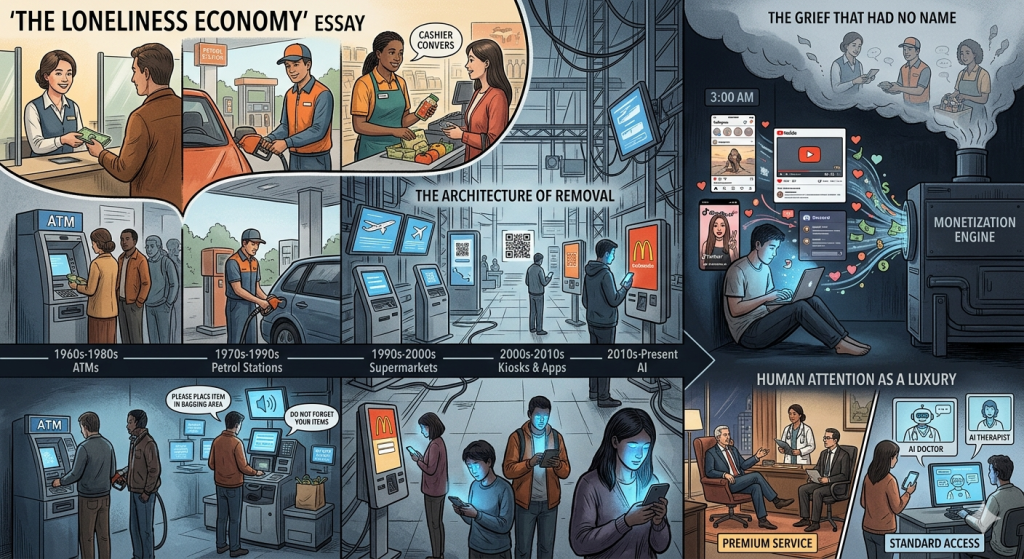
The timeline is instructive:
- 1960s–1980s: ATMs replace bank tellers for routine transactions. Presented as convenience and access. Labor costs fall; bank profits rise.
- 1970s–1990s: Self-service petrol stations spread across the United States, then Europe. The forecourt attendant becomes a relic. The saving is passed to shareholders, not customers.
- 1990s–2000s: Supermarket self-checkout arrives. Customer service desks shrink. The labour of scanning and bagging is transferred, silently and without compensation, to the shopper.
- 2000s–2010s: Airlines, hotels, fast food chains automate customer-facing interactions. The kiosk replaces the counter. The app replaces the desk. The interface replaces the person.
- 2010s–present: AI enters healthcare, education, legal services, mental health support. The frontier moves from physical transactions into the domains that were supposed to be untouchable.
What this timeline obscures is the social texture of what was lost. These were not merely transactions. For an elderly person living alone, the exchange with the checkout operator might have been one of the few moments of human acknowledgment in a day. For anyone navigating a bureaucracy in a language not their own, a human face was not a luxury — it was comprehension, patience, grace.
These things are impossible to put in a spreadsheet. So they were never put in a spreadsheet. And decisions made without accounting for them accumulated, quietly, into a transformation of what ordinary life feels like from the inside.
Nobody held a funeral for the petrol station attendant. The losses were too small, too gradual, too easily reframed as progress. So the grief went sideways.
The Grief That Had No Name
By the 2010s, loneliness had become a public health crisis in most wealthy nations. Researchers reached for explanations: urbanisation, family breakdown, longer working hours, the decline of civic institutions. All true. But one cause was almost never named directly: the systematic removal, across fifty years, of the incidental human contact that had structured daily life.
People felt the deficit without being able to name it. You cannot mourn a petrol station attendant you never thought about while they were there. You cannot grieve a checkout operator as an institution. The loss was too diffuse, too ordinary, too thoroughly explained away as modernity.
So the grief went looking for somewhere to go. And it found Instagram. It found TikTok. It found YouTube personalities who uploaded every day and felt, through the parasocial magic of the medium, like friends. It found comment sections and Discord servers and the particular warmth of being part of an audience, even if the performer did not know you existed.
This was not stupidity or weakness. It was people doing what humans have always done: seeking connection where it is available. The platforms had simply positioned themselves at the exact point where the deficit was greatest. They offered the sensation of social presence — faces, voices, responses, community — without any of the friction, vulnerability or reciprocity that real human relationships require.
It was, in retrospect, a perfect product-market fit. The market was manufactured loneliness. The product was simulated connection. And it scaled beautifully.
Was This Designed?
Here is the question that cannot be avoided: was any of this deliberate?
Not in the sense of a coordinated plan. There was no meeting at which executives decided to make society lonelier so that their platforms could profit from the loneliness. The conspiracy theory version is both too dramatic and too comforting — it implies a human villain who could, in principle, be stopped.
What actually happened is more systemic and therefore more difficult to address. Each individual decision — install the ATM, remove the attendant, deploy the kiosk — was made by people following rational incentives within a system that rewarded labour cost reduction and punished inefficiency. No single actor caused the outcome. The outcome emerged from the aggregate logic of the system.
But then consider what happened next. Facebook’s own researchers found, and documented internally, that its platform was making users feel worse. The company shipped it anyway. Platform engineers designed infinite scroll, variable reward notifications, and autoplay specifically to maximise the time users spent in states of compulsive engagement. These are not the decisions of people who accidentally stumbled onto a mechanism for harvesting loneliness. These are the decisions of people who understood the mechanism and optimised it.
A conspiracy can be exposed and dismantled. What we have instead is a system where every actor follows rational incentives, nobody is explicitly culpable, and the cumulative result is the destruction of human connection as a common good.
So the honest answer is: not manufactured by design at the start, but maintained by design once the profit mechanism became clear. The loneliness was emergent. Its monetisation was deliberate. And at each stage of the process — automation, platform capture, AI deployment — someone got very rich.
The Final Act: Human Attention as a Luxury
Into this landscape arrives artificial intelligence, and it does not arrive as something new. It arrives as the completion of a fifty-year project. The ATM removed the banker. Self-checkout removed the cashier. The kiosk removed the counter. AI removes the professional — the doctor, the therapist, the teacher, the lawyer — or rather, it removes them for those who cannot pay to keep them.
Because this is the final and most revealing sorting mechanism. Every previous wave of automation fell disproportionately on those with the least power — the workers whose jobs were eliminated, the customers with too little leverage to demand human service. AI continues this logic but extends it upward, into domains that once felt protected by their complexity and intimacy.
Wealthy patients will still see physicians who sit with them and remember their history. Their children will still have tutors who know their particular mind. They will have lawyers who pick up the phone, advisors who know their name, assistants who are human. The AI will be for everyone else — and it will be presented, as everything before it was presented, as democratisation. Access for all. The same intelligence, available to everyone.
But access to a tool is not the same as access to human regard. What is actually being rationed is attention — genuine, present, personally invested human attention. And like all scarce things in a market society, it is sorting itself by price.
Human interaction is becoming a luxury good. Not metaphorically. Literally. The presence of another person — someone who chooses to attend to you, who brings judgement and care and the weight of their own experience — is becoming something you pay a premium for, if you can afford it at all.
What Can Be Said
None of this was inevitable. It is the product of specific choices made within a specific economic logic, and different choices remain possible. We could decide that certain domains require human presence as a matter of democratic principle, not market allocation. We could tax the efficiency gains of automation in ways that fund human labour in high-contact roles. We could refuse the framing that equates access to a system with access to the thing the system is supposed to provide.
We could, at minimum, name what has happened. The loneliness was not an accident of modernity. The platforms did not create a need out of nowhere. The grief people carry into their phones at midnight, scrolling for some feeling of warmth and recognition, is the grief of a society that decided, fifty years ago, that human contact was a cost to be eliminated — and is now, slowly, discovering what that decision cost.
The machine at the petrol station. The screen at the supermarket. The chatbot at the hospital. The influencer at three in the morning. These are not separate phenomena. They are one phenomenon, unfolding across decades: the conversion of human connection from a common good into a commodity, and the harvesting of the loneliness that remained.
That is predatorialism. Not a conspiracy. A system. And systems, unlike conspiracies, require more than exposure to dismantle. They require the willingness to build something deliberately different — to decide that some things are not for sale, and mean it.