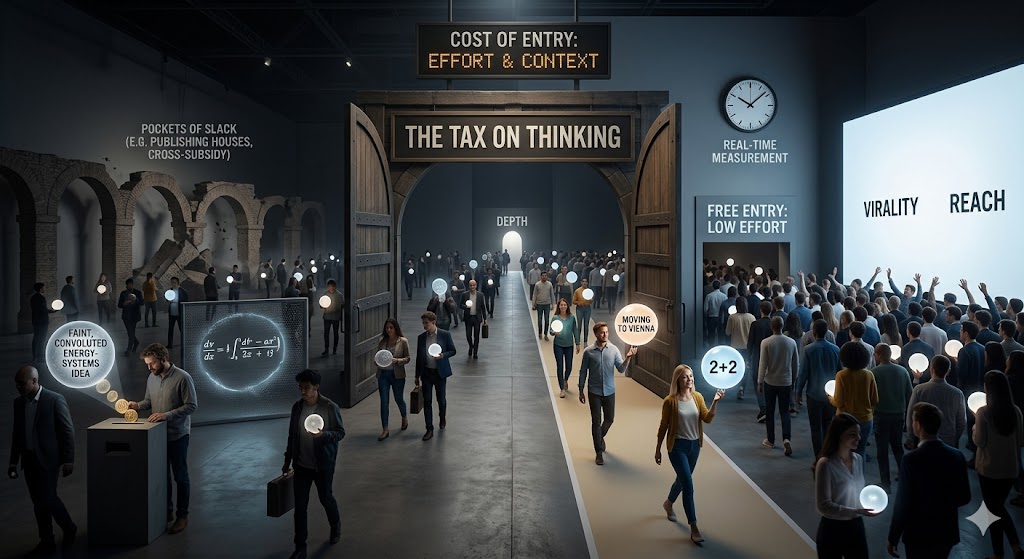
Why the cheapest ideas win, why they always have, and who’s collecting.
A man posts for years about the future of AI, robotics, geopolitics, energy systems — the actual levers of the world — and receives, in his own words, a humble echo. Then he posts that he is moving to Vienna, and the room erupts. Thousands of views. Hundreds of messages. The move, he admits, is irrelevant.
Most people read this as a story about the audience being shallow. That reading is comforting and wrong. The audience isn’t shallow. The system is doing exactly what it was built to do, and the move-to-Vienna post simply paid the lowest entry fee in the room.
Reach is not a measure of value. It is a measure of access.
Every idea charges an admission price before anyone can react to it. The price is the amount of thinking required to engage. Some ideas are free at the door. Anyone can react to “I’m moving to Vienna” because everyone already carries the context: a move is a new chapter, a life change, something human. No prerequisites. No homework. Everyone in the world is pre-qualified to respond.
A post on the architecture of energy systems charges a different price. To react meaningfully, you need to already hold the context — the vocabulary, the stakes, the why-this-matters. Most people don’t, so most people don’t pay. Not because they’re incapable, but because engaging would cost them something, and scrolling is free.
So the spread of an idea is governed by a single variable that has nothing to do with its worth: how many people can react to it without effort. Virality is a popularity contest, and popularity is always decided by the lowest common denominator, never the highest. The denominator is the point. It’s the divisor everything else is forced down to.
The mechanics, stated plainly
Picture two things on a screen. One is 2 + 2. The other is a differential equation.
Almost everyone reacts instantly to the first. They get it, they feel the small pleasure of getting it, they engage. The equation produces silence — not because it’s wrong, not because it’s unimportant, but because it filters its own audience down to the people already equipped to read it. The arithmetic keeps the whole room. The equation keeps the few who did the prior work.
This is the entire engine, and it produces a brutal asymmetry that runs in one direction only:
- A profound idea requires shared context to land. The fewer people who already hold that context, the smaller the echo — no matter how true the idea is. Truth buys you nothing here. Prerequisites cost you everything.
- A simple idea requires nothing. Everyone is already qualified. So it travels, and it keeps travelling, because each person who shares it hands it to another room full of people who are also, already, pre-qualified.
The simple idea isn’t winning because it’s better. It’s winning because it removed the tax. And the thing being taxed is thinking.
The second tax: taking a position
There’s a subtler fee, and it’s the one most people miss. The cheap idea isn’t only easier to understand. It’s easier to agree with — and agreement, not comprehension, is what actually gets shared.
“Moving to Vienna” isn’t merely low-effort. It’s unobjectionable. Nobody disputes it. There is no version of you that looks foolish for liking it, no argument it drags you into, no position it pins you to. A specific claim about energy systems can be wrong. It can be contested. Sharing it stakes a flag, and the flag can be shot at. So the act of sharing carries a social risk that scales with exactly how much the idea commits you to.
This means the system doesn’t just tax thinking. It taxes standing for something. The frictionless ideas are frictionless in part because they ask nothing of your identity — you can pass them along at zero risk because they say nothing anyone could hold against you. The result is a quiet, compounding bias not merely toward the simple, but toward the safe. Even a simple idea that takes a real position underperforms a simple idea that takes none. The denominator rewards the inoffensive twice: once for being easy, once for being weightless.
This is not new. Don’t pretend it is.
Here is the rebuttal that arrives on schedule: this was always true. Look at what’s popular in cinemas, on bestseller lists, on Netflix. And it’s correct. The most-printed books in history are scripture and political slogans and boy wizards — not the most profound texts ever written, the most accessible ones that hit a vast pre-qualified audience. Hollywood’s highest grosses are spectacle and franchise, not the films critics canonize. The most-watched things on streaming are the ones you can follow while half-looking at your phone. Penny dreadfuls outsold literature. Serialized melodrama. Pulp. The denominator has always been the divisor.
So concede it immediately, because conceding it makes the point worse, not better. The cost-of-entry mechanism is ancient. It isn’t a glitch of one platform or one algorithm. It’s a structural property of mass distribution itself — older and more load-bearing than anything with a feed. Every medium that has ever reached many people has selected for the cheapest entry fee.
But the gatekept eras had something we no longer have: a counterweight.
A publishing house could lose money on profound books and recoup it on bestsellers. Cross-subsidy. A studio kept screens for prestige films it knew wouldn’t open big. A newspaper ran the investigation nobody clicked, because the institution had a reason to exist beyond the performance of any single item. The economics were lumpy and slow. Reach was measured in seasons, not seconds. And in that slowness there were gaps — pockets of slack where a thing could survive being unpopular long enough to matter.
Depth lived in the gaps. It was never what sold the most. It just didn’t have to.
What we broke on the supply side
The change isn’t that audiences got shallower. They didn’t. The change is that the feedback loop got tight enough to strip out the gaps.
When reach is measured per-item, in real time, and that measurement directly sets both distribution and reward, the slack disappears. There is no longer a season in which the unpopular thing is carried. There is no longer an institution absorbing the loss on your behalf. Every post, every upload, every release is priced at the door, instantly, against the lowest common denominator — and whatever doesn’t clear it is simply not distributed.
The cross-subsidy collapses. And once it collapses, the medium stops being able to afford depth, even when the people inside it still want to make depth. This is where a taste problem becomes a selection mechanism. Watch what happens once creators internalize the price structure. They stop optimizing for what’s true and start optimizing for what’s free at the door, because the reward is paid for frictionlessness, not insight. Over enough cycles the system doesn’t merely distribute lowest-common-denominator content. It manufactures it. The denominator stops being a description of the audience and becomes a design spec for the supply.
What we broke on the demand side: the wait got abolished too
The supply side explains why the system distributes cheap ideas. It doesn’t explain why the audience accepts them. For that, look at what happened to patience.
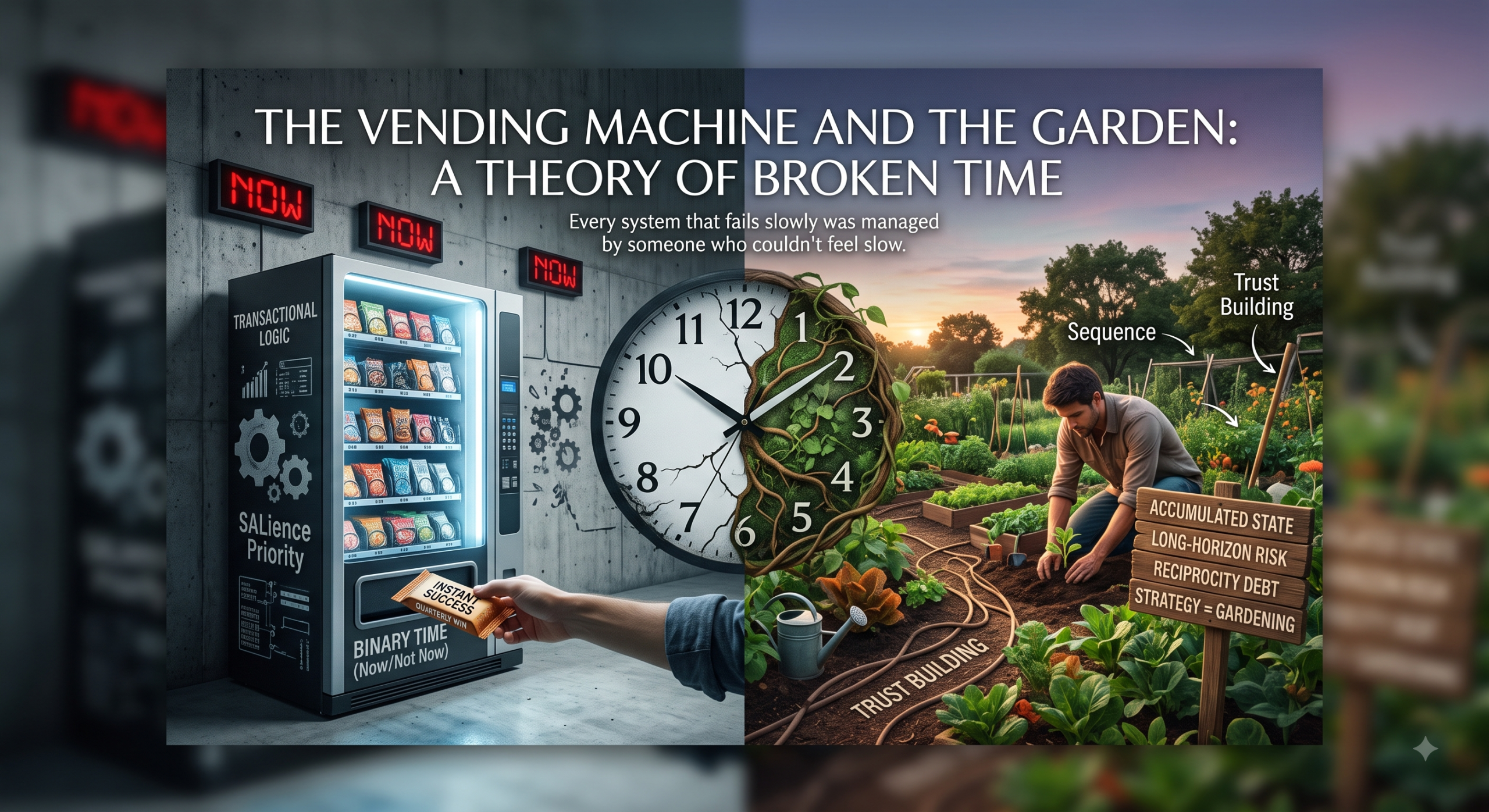
Cost-of-entry only works as a filter if the audience is unwilling to pay. A patient reader would pay the thinking-tax, sit with the equation, and let it spread. Instant gratification collapsed that willingness to near zero. The scroll trained a reflex: every swipe delivers a hit, the next is always one thumb-flick away, and abandoning anything that doesn’t pay off immediately costs nothing. So the reader is no longer deciding “is this worth thinking about.” In under a second they’re deciding “does this reward me right now.” And depth, by definition, defers the reward. It asks you to hold tension before the payoff lands — the single thing a gratification-trained nervous system has been conditioned to refuse.
Notice this sharpens the “it was always like this” point one more notch. The penny-dreadful reader still had to wait — for the next installment, for the book to arrive, for the film to open. Friction wasn’t only at the door; it was baked into time itself. And because everything required patience, patience wasn’t a competitive disadvantage. Scarcity and delay did some of depth’s protective work for free.
Instant access didn’t just remove the wait for cheap content. It repriced patience itself — from neutral to costly. And depth is the one asset denominated entirely in patience. So the loop closes and ratchets: the supply side selects for low entry cost, the demand side has been trained to refuse any entry cost, and each makes the other worse. The feed got faster because attention got shorter; attention got shorter because the feed got faster. No first mover to blame. It only turns one way.
Who’s collecting the tax
So far this reads like weather — a mechanism with no beneficiary, an unfortunate emergent property nobody chose. That’s the comfortable version, and it’s the wrong one.
The platform is not a neutral pipe faithfully surfacing what the audience prefers. It is optimizing for one number: time on platform. And cheap, instant, agreeable content maximizes that number better than anything else ever invented. The shortened attention span isn’t a side effect the platform reluctantly tolerates. It is the product — your attention, fragmented into the smallest resellable units, auctioned to advertisers by the impression.
Which means the tax on thinking has a collector. It isn’t levied by “the medium” in the abstract, and it isn’t paid to the audience in the form of things they secretly wanted. It’s paid in your attention, and the revenue accrues to whoever owns the feed. The reflex you mistake for your own impatience was, in large part, manufactured — because a patient user is a less profitable user. Patience reads the long thing, leaves the app, thinks for a while. That’s lost inventory.
This is the indictment hiding under the lament. The system didn’t drift toward shallowness by accident. Shallowness is what it sells, and the depletion of your attention is not a cost it bears. It’s the cost you bear, so that the thing can be sold.
The trap — and the part that isn’t despair
The obvious misread of all this is cynicism: so dumb everything down, nothing deep can win, give the mob its arithmetic. That’s lazy, and it’s not what the mechanism implies.
The mechanism says reach is priced by cost-of-entry. It does not say substance and reach are mutually exclusive. It says they’re traded off by default — because most people build the equation and then complain the room is empty.
The actual skill, the rare one, is lowering the cost of entry without discarding the substance. Not turning the equation into arithmetic — turning it into something a person can step into and feel the weight of, even if they could never have derived it themselves. The move-to-Vienna post had zero substance and zero entry cost. The energy-systems post had high substance and high entry cost. Almost nobody builds the third thing: high substance, low entry cost. That quadrant is nearly empty, and in a world with no cross-subsidy left to carry depth and no patience left to wait for it, it’s the only quadrant where depth survives.
The best communicators don’t choose between profound and simple. They smuggle the profound inside the simple. They pay the reader’s entry fee at the door, and only once the reader is inside do they reveal there was something heavy in the room all along.
The one-line version
The cheapest ideas always won — but there used to be gaps where the expensive ones could survive being unpopular, and patience used to be free. We closed the gaps and made patience costly, then handed the whole apparatus to someone who profits from your attention being spent rather than kept.
The scandal was never that the audience is shallow. It’s that we took the mechanisms that used to protect depth from the denominator — the cross-subsidy, the wait, the room to be unpopular — and we optimized them away, on purpose, for someone else’s revenue.