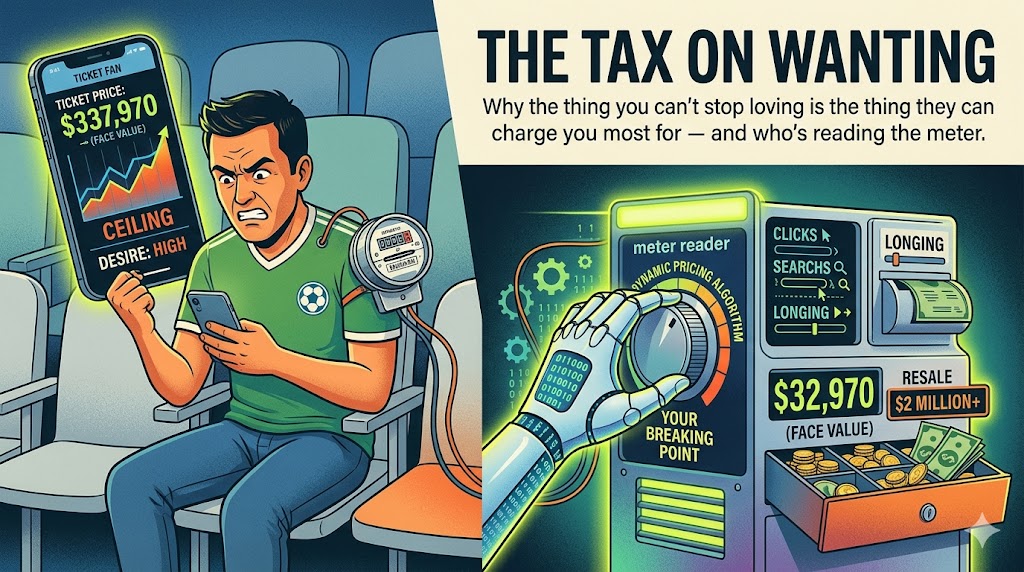
Why the thing you can’t stop loving is the thing they can charge you most for — and who’s reading the meter.
For two World Cups, the best seat in the house barely moved. A front-row ticket to the 2018 final in Moscow ran about $1,100. Four years later, to watch Argentina and France in Qatar, roughly $1,607. A rise, yes, but a human one — the kind of number a normal person could be angry about and still, somehow, find.
This summer the same seat — the same ninety minutes, the same final, the same patch of grass — reached $32,970 at face value, with listings on the resale market climbing past two million dollars.
Nothing about the seat changed. It got no closer to the pitch. The game it overlooks is no more important than the one in Moscow. So before we argue about whether that’s fair, it’s worth asking the colder question underneath it: if the seat didn’t change, what exactly went up?
A price used to describe the thing. Now it describes you.
For most of economic history, a price was a fact about an object. The seat cost what the seat cost. You could think the price was too high, but it was at least about the seat — it sat on the thing like a label, the same label for everyone who walked up to buy.
Dynamic pricing quietly severs that. The number is no longer attached to the seat. It’s attached to the room. An algorithm watches how badly people want in — clicks, searches, the speed at which inventory empties — and moves the price in real time to match. Two fans can buy identical seats, side by side, at wildly different prices, because the seat was never what either of them was being charged for.
What’s being priced is the wanting. The seat is just where the meter is mounted.
This is the reframe that matters, and it’s the one most of the outrage misses. People are angry that tickets are expensive. The deeper thing is that the price has stopped being a fact about the world and become a reading of the buyer. You are no longer paying what the seat is worth. You are paying what your desire for it is worth — to them.
The mechanics, stated plainly
We’re taught that a market is price discovery. A willing seller, a willing buyer, and a number they meet at in the middle — the seller wanting more, the buyer wanting to pay less, the price the truce between them.
Dynamic pricing is not that. It does not look for the middle. It looks for your ceiling — the most you’ll pay in the half-second before you flinch — and sets the price there. It isn’t discovering a fair value; it’s locating your breaking point and stopping just short of it. The “right price,” under this logic, is defined as the highest number that doesn’t make you close the tab.
And the input it reads to find that ceiling is the one variable a real fan cannot lower: how much they want it. A casual buyer flinches early, so the algorithm learns their ceiling is low. The lifelong supporter — the one who has waited a literal lifetime for the World Cup to come to their city — never flinches, so the machine learns there is no ceiling at all. The system is built to charge each person the exact maximum their longing will bear. It is, with no exaggeration, a device for converting how much you love something into how much you pay for it.
The second meter: scarcity you can manufacture
There’s a quieter mechanism running alongside the first, and it’s the one regulators have started circling.
A price that floats on demand creates an obvious temptation: if you can make demand look hotter, the number climbs on its own. So the inventory gets released in staged windows rather than all at once. Seats trickle out. A lottery decides who even gets to buy. Each drop looks like a near-sellout, and the floating price reads that engineered urgency as real heat and rises to meet it. The attorneys general of New York and New Jersey opened an investigation this spring into exactly this — among other things, allegations that sales were staggered to inflate demand and justify the hikes, and that fans were misled about where their seats actually were.
Then there’s the part that should make even the defenders pause. FIFA runs its own resale platform — and takes a cut from both the seller and the buyer on every transaction. Which means the body that sells you the ticket, sets its reserve price, and runs the algorithm that prices it also profits a second time when that ticket is flipped, and a third time when it’s flipped again. The scalping that dynamic pricing was supposedly invented to defeat is, on FIFA’s own marketplace, just another line of revenue. The house doesn’t only set the odds. It owns the resale.
This is not new. Don’t pretend it is.
Here’s the rebuttal that always arrives: this is just how everything is priced now. And it’s true. Airlines have done it for decades. Hotels. Ride-hailing surges when it rains. Ticketmaster has been letting concert prices float for years; the Super Bowl clears five figures; the San Francisco Giants pioneered the practice in baseball back in 2009 and the rest of American sport followed. FIFA itself ran dynamic pricing at last year’s Club World Cup as an open test run before pointing it at the main event. None of this is a glitch. It is the dominant pricing logic of the age, and pretending the World Cup invented it only makes you look like you haven’t been paying attention.
So concede it completely — because conceding it makes the point worse, not better.
The mechanism is old. What’s new is the target. A plane seat is substitutable; you can fly Tuesday instead of Monday, or not fly at all. A concert is discretionary. Surge pricing on a rainy night is annoying but escapable. The World Cup final is none of those things. It happens once every four years, it is singular and non-substitutable, and for most of the people who love it, it is a once-in-a-lifetime event arriving in their own country. You cannot buy the off-peak version. There is no Tuesday final.
Dynamic pricing has always worked best on demand that can’t walk away. Aiming it at the most inelastic, most emotionally loaded, least substitutable cultural event on earth isn’t a new tool. It’s the old tool finally pointed at the thing people will give up almost anything to have.
Why the thing you love is the perfect prey
This is the cruelty hiding in the arithmetic, and it’s worth saying without flinching.
Dynamic pricing extracts the most from the people who can least bring themselves to refuse. Its efficiency is a direct function of how badly you want the thing. Indifference is the only real defense in a market that prices your desire — and indifference is precisely what a true fan does not have. The casual buyer’s flinch protects the casual buyer. The devotee has no flinch, and so the machine can take everything.
Which means the system runs a perverse selection: it charges you in proportion to your love. The more the World Cup means to you, the more you pay for it. Passion, the thing that makes the event worth attending at all, is reclassified as a vulnerability — the single most reliable input for setting your personal price. The people the game claims to be for are the people the pricing is optimized against.
Who’s collecting the tax
So far this can still be read as weather — an impersonal market doing impersonal market things, no villain, just supply meeting demand. That’s the comfortable version, and it’s the wrong one.
FIFA’s president has defended the prices as simply adapting to the North American market, and as recapturing money that would otherwise have leaked to scalpers. Read that justification carefully, because it’s an admission dressed as a defense. “Adapting to the market” means: we found out how much you’d pay, and we decided to charge it. “Recapturing scalper revenue” means: we noticed someone was profiting from your desperation, and we decided it should be us.
The meter has an owner. FIFA sets the reserve price, runs the algorithm, gates the lottery, operates the resale, and clips both sides of every flip. The tax on wanting is levied on your love of the game and remitted, in full, to the institution that governs it. Your passion is not a side effect the system reluctantly tolerates on the way to selling tickets. Your passion is the product — metered, priced, and sold back to you at the rate of your own longing.
The trap — and the part that isn’t despair
The lazy read of all this is surrender: everything is a racket now, pay up or stay home, the rich get the seats and that’s the world. That’s cynicism wearing the costume of realism, and it isn’t what the mechanism actually implies.
The mechanism says the price reads your desire. It does not say your desire has to stay readable, or that the reading has to go unchallenged.
Collectively, the levers are real and already moving. The investigations into the staggered sales. The petitions demanding resale caps and blocks of tickets reserved for local residents at fixed prices. Price ceilings — crude, unfashionable, and the one thing a demand-reading algorithm genuinely cannot route around, because a cap is a refusal to let the meter run. Whether any of it lands is a political question, not an economic one. Dynamic pricing is not a law of nature; it’s a choice that can be un-chosen, and the only reason it feels inevitable is that it’s profitable enough to be defended as inevitable.
Individually, the honest answer is smaller and harder. The single number this machine cannot raise is the one attached to a buyer who is genuinely willing to walk — and the tragedy is that, for the thing you love most, you usually aren’t. That’s the whole trap. So the realistic defense isn’t to stop wanting; you can’t, and you shouldn’t have to. It’s to see the meter. You cannot be quietly extracted from once you know that the price tag is a mirror — that the number isn’t telling you what the seat is worth, it’s telling you what they’ve calculated your heart is worth. Naming that is the tax’s only natural enemy. It doesn’t lower the price. It just ends the part where you mistake the reading of your own desire for the fair value of a thing.
The one-line version
The last machine taxed your attention — it charged you for being curious, and remitted the fee to whoever owned your feed.
This one taxes your love. It doesn’t ask what the seat is worth. It asks what you’d be willing to lose to sit in it, and it bills you for the answer.
Same meter. New mirror. And the more you want it, the more it costs.
This is the second entry in a series on the systems quietly converting human traits into someone else’s revenue. The first, on attention, is The Tax on Thinking.