Or: what happens to a country when its wage bill becomes someone else’s export revenue.
The comfortable story
The comfortable story about AI and national economies is told in productivity language. AI will make our companies more efficient. Efficiency means growth. Growth lifts everyone. The story is usually delivered alongside its companion piece, the reindustrialization promise: we’re bringing the factories back, chips acts and gigafactories and strategic autonomy, the middle class restored through manufacturing the way it was built the first time.
Both stories share one convenient omission. They talk about what AI does inside the country and stay silent about where the money goes when it leaves. And it leaves.
The mechanism
Follow a single salary, because the whole argument lives in the plumbing.
A receptionist’s salary in Munich is not just a cost on an employer’s books. It is domestic circulation. It gets spent at the bakery, the landlord, the supermarket. It gets taxed, and the tax feeds pensions, health insurance, schools. Roughly speaking, a euro of wages in Germany is a euro that keeps moving through Germany, touching the state at every turn. That circulation is not a side effect of employment. It is most of what a national economy is.
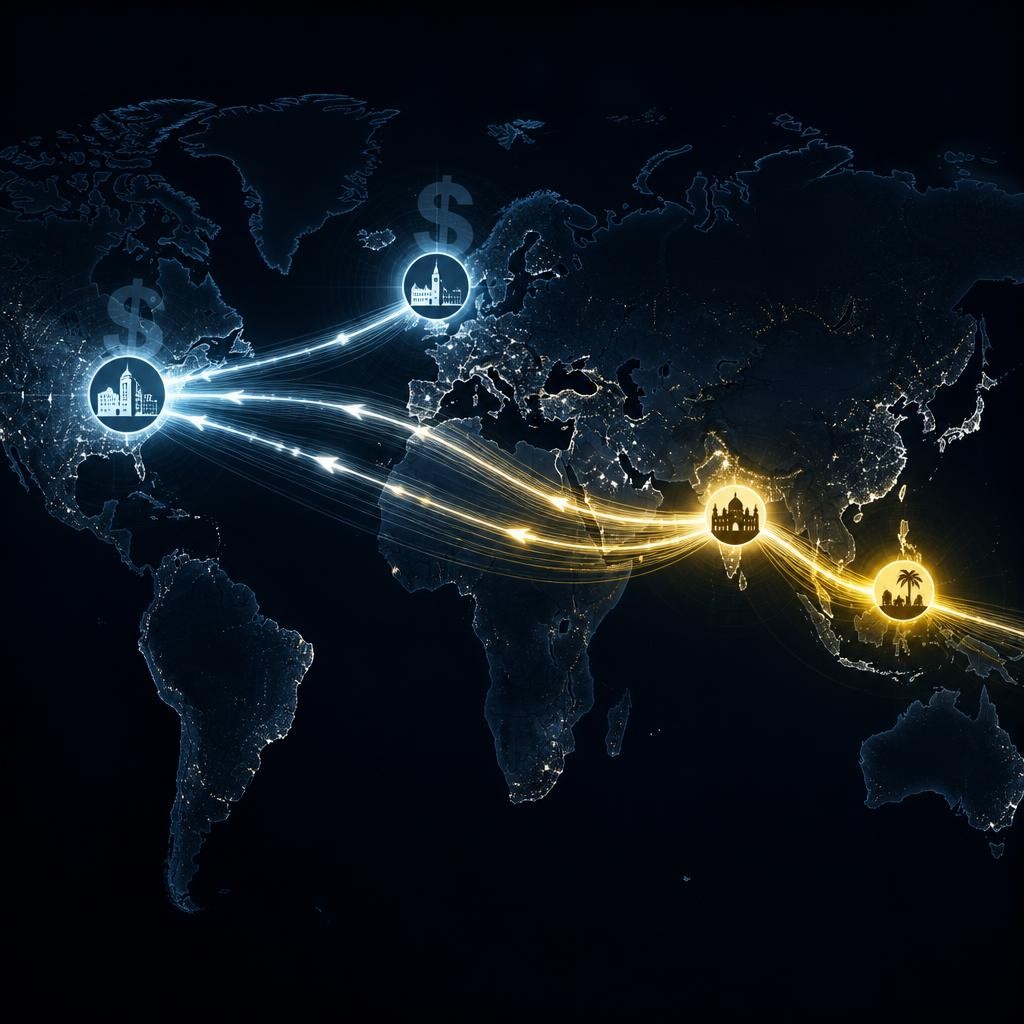
Now replace the receptionist with an AI agent. The work still happens, cheaper and around the clock, and the employer’s margin improves, which is why it will happen regardless of anyone’s feelings. But look at the plumbing. The salary is gone, and in its place is an inference bill. That bill is paid to a model lab and a hyperscaler, and with marginal exceptions, those sit in the United States. What used to be a domestic wage, circulating and taxed, is now an import, exiting and untaxed on its way out.
Scale that from one receptionist to a measurable share of a services economy, and you get the mechanism in one sentence: AI adoption converts national wage bills into balance-of-payments outflows. The country doesn’t just lose the job. It loses the circulation the job powered, and the money resurfaces as revenue in someone else’s economy, on someone else’s stock market, taxable by someone else’s state.
Fashion has an exact name for this position. The countries that don’t own textile machinery don’t stop wearing clothes. They import them, and the margin lives where the looms live. In the AI economy, the loom is the frontier model plus the data center it runs on. A handful of countries own looms. Everyone else rents.
The ladder has no down direction
This essay closes an arc, so place it in the sequence. Fast software showed what happens when production cost collapses: industries reorganize around a new scarce resource. The wage map showed that AI adoption follows the buyer’s alternative labor cost, not innovation appetite. The wire essay showed who gets hit first: the economies that made millions of jobs wire-shaped, Manila and Bangalore, whose development ladder loses its bottom rungs before prosperity compounded.
Here is the symmetry that completes it. Western economies are standing at the top of that same ladder. Seventy percent and more of their output is services, and a large share of those services are wire-shaped: desk work, screen work, language work. The wire that reached Manila first reaches Frankfurt and Columbus on a delay, not an exemption.
And the ladder has no down direction. The reindustrialization story imagines climbing back to the manufacturing rung, but the factories being reshored are not the factories that left. A modern fab or gigafactory is capital with a thin crust of payroll: thousands of jobs where the old plants carried hundreds of thousands, and a good share of those thousands are wire-shaped desk roles anyway, procurement and planning and compliance, exactly the work the wire eats. The West is not going back to industry. It is building industry that looks like software: enormous capital, minimal circulation. You cannot rebuild a middle class on a building that mostly employs machines, financed by capital that mostly rewards its owners.
So the two moves available in the old playbook, climb up into services or climb down into manufacturing, both end at the same door. Behind the door is the loom question: who owns the thing the whole economy now pays rent to.
Who collects
The United States collects twice, and the double collection is the story. When an American firm automates a desk, the wage disappears but the inference spend stays onshore: the lab is domestic, the hyperscaler is domestic, the data center’s power bill and the resulting market capitalization are domestic. America eats its own jobs and keeps the calories. When a German firm automates the same desk, the wage disappears and the spend emigrates. Europe pays twice: the job goes, and the margin leaves. Same technology, opposite national outcome, decided entirely by loom ownership.
Europe’s position deserves to be named without mercy, because it is the worst seat at the table. The highest wage floors in the world make the automation delta irresistible, so adoption is guaranteed. And no frontier loom of consequence is European-owned, so the delta exits. Yes, there is Mistral, roughly a billion dollars in revenue and growing fast on the sovereignty pitch, and yes, Brussels is pouring money into AI factories. Eat the counterargument whole: it is real, it matters, and it is an order of magnitude short. European compute capacity remains a fraction of what single American sites deploy, and the flagship sovereignty champion expands its infrastructure in partnership with Microsoft, which is a sentence that refutes itself. Renting a loom through a domestic broker is still renting.
The Gulf read the mechanism early and answered it with the only tool it has: capital. Sovereign funds buying stakes in the labs and building national compute are attempts to buy into loom ownership directly, to convert oil rent into inference rent before the first stream thins. Whether it works is open. That they understood the game is not.
And the wire economies from the last essay hold the weakest hand of all: they lose the wage jobs and they never had a seat in the loom auction. The ladder is cut below them and the rent flows past them.
Who pays, everywhere, is the same party: the domestic circulation. The bakery, the tax base, the pension system, the local everything that a wage used to feed and an inference bill starves.
The refusal
The cynical ending is geopolitical fatalism: the loom is owned, the rent flows one way, small countries should get comfortable as tenants. Accurate about the present, lazy about the degrees of freedom that remain.
Because loom ownership is not binary, and the rent has more than one layer. The model layer is nearly closed, but the layers above it, the applications, the domain systems, the audit-grade infrastructure built on top of rented inference, are where most of the eventual value will sit, exactly as most of fashion’s value sits in brands, not looms. A country that cannot own the model can still own the workflow, the trust layer, the regulated verticals, and keep that circulation domestic. Europe’s actual advantage, its dense regulatory fabric, is the one input America cannot manufacture, and building the compliance-native layer of the AI economy is a loom of its own.
For states, the honest agenda is equally concrete: treat inference dependence as an import dependency like energy, because it is one, and diversify it the way you learned to diversify gas. Tax and account for the outflow honestly instead of hiding it inside productivity statistics. And when subsidizing “AI adoption,” notice whether you are subsidizing domestic capability or subsidizing your own wage bill’s conversion into a foreign utility payment.
The Industrial Revolution’s brutal lesson was never that machines destroy work. It was that the geography of machine ownership decides the geography of prosperity for a century afterward. Everyone can see the machine this time. The question every country should be asking is not what does AI do to our jobs. It is: when our wages become rent, whose loom are we paying, and what, exactly, do we own that pays us back.