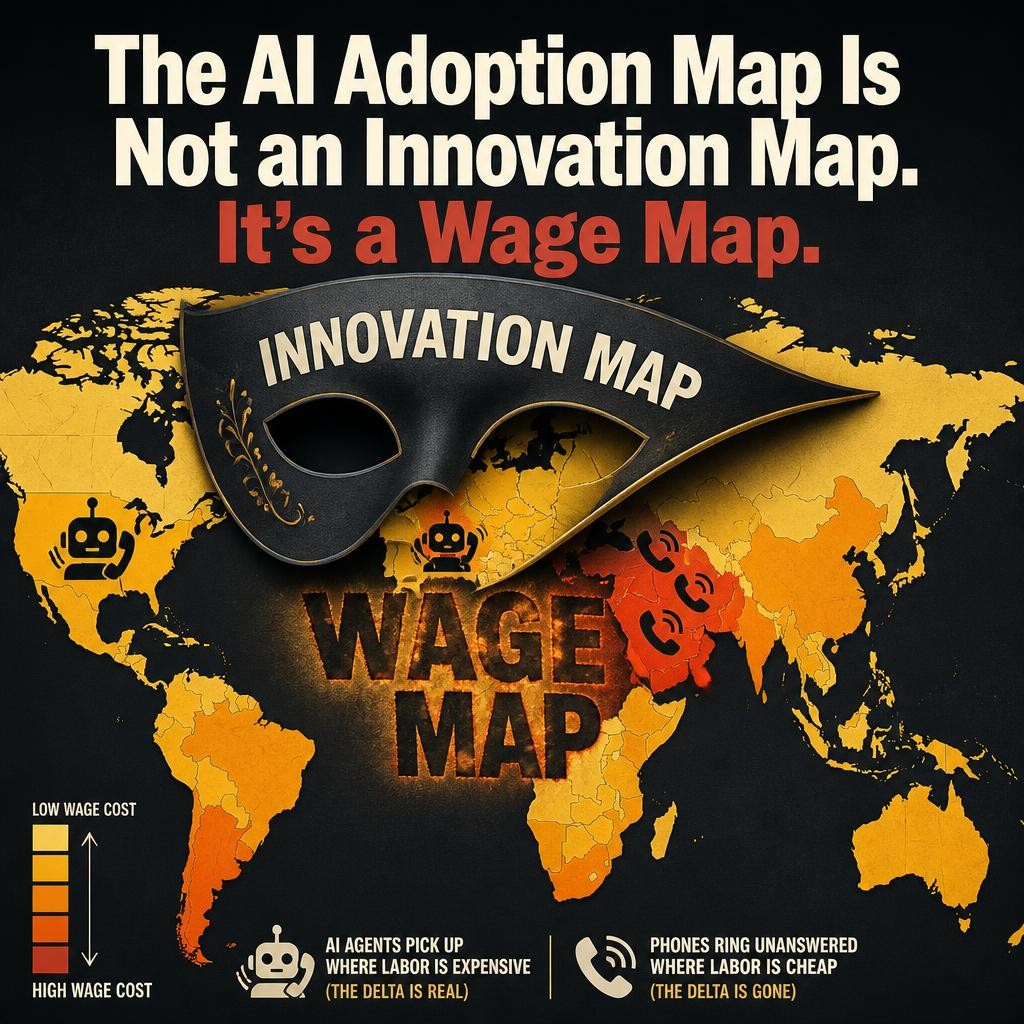
Or: the AI adoption map is not an innovation map. It’s a wage map.
The comfortable story
The comfortable story about AI agents goes like this: adoption follows innovation. Voice agents are taking off in the US and starting to spread in Europe because those markets are technologically mature. Where they haven’t landed yet, the market just isn’t ready. Germany is slow because Germans are conservative. The Gulf is slow because… well, nobody ever finishes that sentence, because the Gulf spent the last decade branding itself as the most AI-forward region on earth. Ministries of AI, national strategies, robot police prototypes for the cameras.
So here is the puzzle the comfortable story can’t solve. Voice agent companies like Fonio are growing fast by answering phones for businesses in Germany and France, two markets nobody accuses of moving fast. Meanwhile in Dubai, a city that talks about AI more than almost anywhere, restaurant groups still run on bare phone lines. No agent, no voicemail, nothing. The phone rings into the void at peak hours and everyone accepts it.
If adoption followed innovation appetite, this would be exactly backwards.
The mechanism
It’s not backwards, because adoption doesn’t follow innovation. It follows the price of the human being replaced.
An AI agent doesn’t compete with “answering the phone.” It competes with the fully loaded local cost of the person who answers the phone. That number is not set by technology. It’s set by wage floors, social systems, and migration regimes, which means it varies by an order of magnitude between markets that look similar on a conference stage.
Run the comparison honestly. In Munich, a receptionist costs the employer 45,000 euros a year before you add nearly thirty percent in social contributions, paid vacation, sick leave, and the works council hovering over every staffing decision. Call it 60,000 euros for one person covering forty hours a week, which is not even half the hours a phone rings. Against that, an agent that costs cents per minute and works every hour of the year is not an innovation decision. It’s arithmetic.
Now run it in Dubai. The person answering the phone is often a worker from the Philippines or Nepal earning 2,500 to 3,500 dirhams a month. No social contributions. No pension. Visa tied to the employer. Six-day weeks are normal. The fully loaded annual cost lands under a tenth of the Munich number. Against that human, the AI agent isn’t obviously cheaper at all. The arithmetic that sells itself in Bavaria collapses at the Trade Centre roundabout.
Same technology. Same use case. Opposite economics. The AI adoption map is a wage map wearing an innovation costume.
The automation already happened
Here is the part the comfortable story really doesn’t want to look at, and it’s the heart of the matter.
The Gulf didn’t skip automation. The Gulf automated early, it just didn’t use machines. The sponsorship-based migration system is a labor cost compression technology, and it is spectacularly effective. It imports service labor from lower-wage economies at scale, prices it far below what any citizen or European worker would accept, strips it of bargaining power through visa dependency, and makes it available around the clock. Functionally, that is what automation promises: abundant, cheap, compliant capacity.
Which means the wage delta that AI vendors feed on in Europe was already harvested here decades ago, by a different predator. An AI agent arriving in Dubai in 2026 is not entering virgin territory. It’s a newcomer walking into a hunting ground where the carcass was stripped long ago. There is no fat delta between “expensive human” and “cheap machine” because the human was already made cheap by other means.
This is why the region can genuinely lead in AI announcements and genuinely lag in AI deployment for service work, with no contradiction. The announcements are about capital allocation and national branding. Deployment is about deltas, and the delta isn’t there.
Who collects, in each market
Name the beneficiaries precisely, because they differ by geography and that difference is the whole story.
In Germany, the AI vendor collects the delta. Every euro between the receptionist’s fully loaded cost and the agent’s inference bill is margin waiting to be split between the vendor and the business owner. That’s why voice agent startups target the German Mittelstand: dentist offices, workshops, restaurants, all drowning in labor costs and unable to hire anyway. The vendor is monetizing a wage floor that the German social system built.
In the Gulf, the sponsor-employer already collected. The margin between what the service worker produces and what the service worker is paid was captured through the migration system, year after year, long before transformers existed. There is nothing left for the AI vendor to offer except a rounding error, and nobody buys transformation for a rounding error.
And notice who pays in each system. In Europe, the displaced receptionist pays with the job. In the Gulf, the worker already paid, continuously, in the gap between their wage and their output. The AI wave doesn’t create the extraction. It reveals where extraction was already priced in.
The complications that prove the rule
Two wrinkles, both of which strengthen the mechanism rather than break it.
Germany has the fattest delta in the world and still adopts slower than the US. That’s because adoption follows the delta minus institutional friction: GDPR, works councils, and a culture where being answered by a machine still reads as disrespect. The US has a large delta and near-zero friction, which is why it leads. The formula holds; friction is just a second variable.
And in the Gulf’s luxury tier, the human answering is not a cost at all. It’s the product. A five-star hotel where a person picks up on the first ring is selling human attention as a status good, the same way a hand-finished garment sells the hours in it. You cannot automate a luxury signal, because the inefficiency is the signal.
The refusal
The cynical reading writes itself: it’s all extraction, the machine eats the European worker and the migration system already ate the Gulf worker, pick your predator. That reading is accurate and useless.
Here’s the useful one. If AI agents can’t win on labor cost in cheap-labor markets, then the only honest pitch there is new value, not substitution. The phone that rings into the void at Friday peak is not a labor cost problem; it’s revenue evaporating because no human, however cheap, is answering at all. Capturing that isn’t replacing a worker. It’s collecting what currently goes to nobody. Vendors who understand this will build for missed demand, overflow, and 3 a.m. coverage, and they’ll grow in Dubai. Vendors who copy-paste the Munich cost-savings deck will keep wondering why the most AI-branded region on earth won’t buy.
And for anyone reading the AI adoption charts as a ranking of which nations are the future: stop. You’re not looking at innovation. You’re looking at the price of a human being, market by market, with all the history that number carries. Read the map for what it actually shows, and it tells you more about how the world is organized than any keynote ever will.