Or: what happens to an industry when making things stops being the hard part.
The comfortable story
The comfortable story goes like this: innovation is accelerating. A new agent framework every two or three weeks is proof of a golden age. More tools, more choice, more progress. If you feel exhausted by the pace, that’s a you problem. Adapt or fall behind.
It’s a flattering story, because it casts the churn as achievement and your fatigue as weakness. It’s also wrong, and we’ve seen this exact movie before. It just played in a different industry.
What happened to fashion
For most of human history, clothing was expensive to make. A garment took skilled hands and real time, so the industry organized around craft: fewer pieces, made to last, judged on how they held up.
Then industrialization collapsed the cost of production. And here’s the part the comfortable story always skips: when making things gets cheap, industries don’t make the same things more efficiently. They reorganize around a new scarce resource. Production was no longer the bottleneck. Attention was.
So fashion rebuilt itself around velocity. Two collections a year became fifty-two micro-drops. The garment stopped being the product; the drop became the product. Quality didn’t just decline as a side effect. It became irrelevant by design, because a piece only needs to survive the hype cycle, not the decade. Shein doesn’t fail at durability. Durability was never in the spec.
The same curve, running again
Now watch software. Less than a year ago, “coding agent” was a niche term. Today a new agent framework, orchestration layer, or dev environment drops every few weeks, each with its own influencer wave, its own launch-day star count, its own two-week reign before the feed moves on.
The mechanism is identical. AI collapsed the cost of producing software. A framework that took a team a year now takes a weekend of scaffolding. And just like fashion, the industry didn’t respond by making the same software better. It reorganized around the new scarce resource: your attention.
Look at what actually gets optimized now. Not maintenance, not security posture, not the boring guarantee that this thing still works in eighteen months. What gets optimized is the launch: the demo video, the thread, the star velocity in the first 72 hours. GitHub stars are the new haul video. “I tried the new framework so you don’t have to” is the same content format as “I bought 40 Shein items, here’s my honest review.”
The artifact is disposable. The moment is the product.
Who collects
Every system that runs like this has a beneficiary, and it is worth naming precisely, because it is not the developer and it is mostly not even the tool builder.
The platforms collect. Attention markets pay whoever owns the feed, and every framework launch cycle is engagement fuel for X, YouTube, and LinkedIn regardless of whether the tool survives.
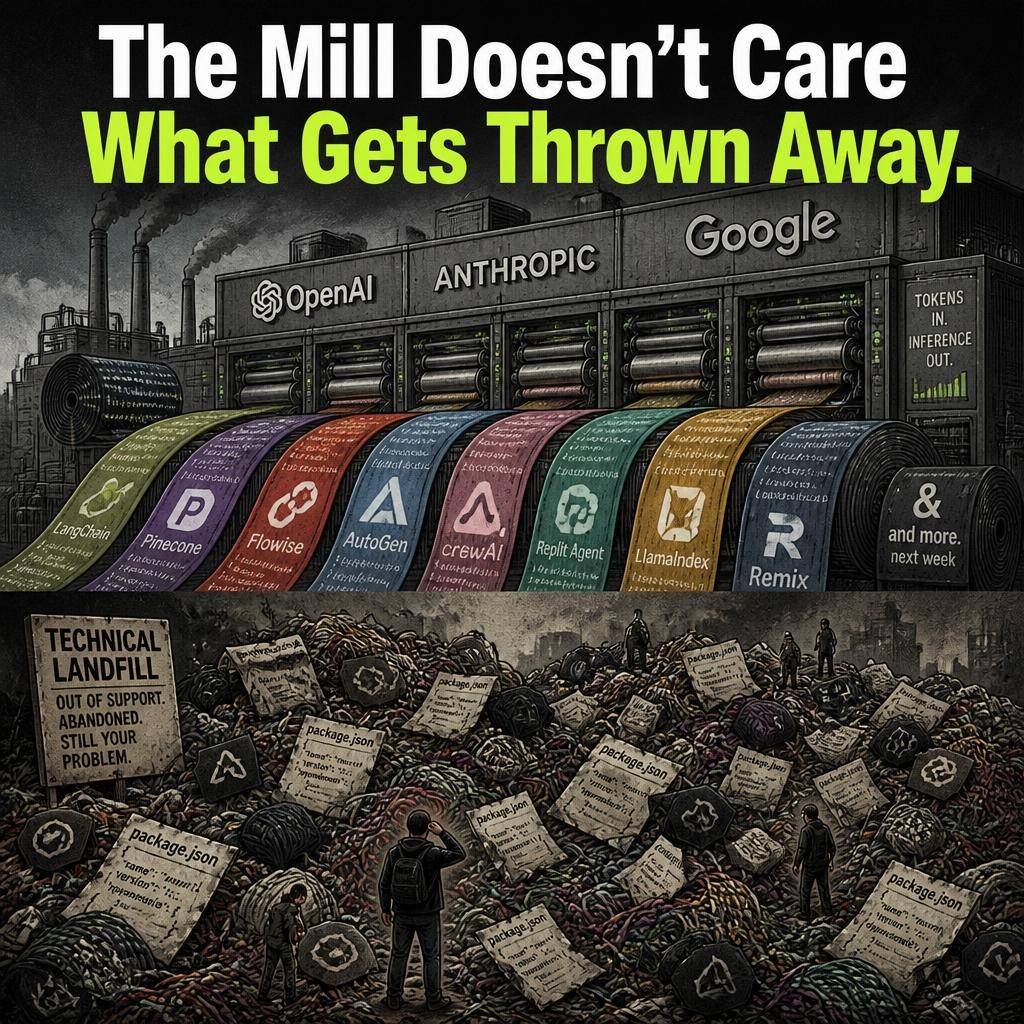
The model labs collect twice. Anthropic, OpenAI and Google are the fabric mills of fast software: they supply the raw material that made production cheap in the first place, and nearly every tool in the churn is stitched on top of their APIs. Every launch, every fork, every abandoned experiment burns tokens. The framework can die in ninety days; the inference bill was paid either way. In fast fashion, the mill doesn’t care which brand’s garment ends up in the landfill. It sold the polyester.
The influencer layer collects. A creator covering the tool-of-the-week earns whether or not the tool is any good, exactly like a haul channel earns whether or not the clothes survive a wash. Their incentive is cadence, not quality, so they will always amplify velocity.
And capital collects, at least on paper. A hype spike is a fundraising event. The tool doesn’t need users in year two; it needs a valuation in month three.
Now look at who pays. Developers pay with the perpetual anxiety of falling behind, the quarterly stack rewrite, the skills that depreciate before they compound. Maintainers pay by holding up abandoned dependencies for free. Companies pay in security debt and in codebases assembled from tools nobody maintains. Fast fashion has landfills in Ghana. Fast software has a technical landfill too. It’s just distributed across a million package.json files, invisible until an audit or a breach makes it visible.
The fatigue you feel is not a failure to adapt. It is the correctly perceived cost of a system that externalizes durability onto you.
The counter-signal
Fashion’s velocity race eventually produced its own opposition: slow fashion, buy-it-for-life, brands like Patagonia whose entire pitch is that the product outlives the trend cycle. That counter-movement only became possible once enough people recognized that the churn was a business model, not progress.
Software has its Patagonias already. SQLite, Postgres, curl. Boring, unfashionable, maintained for decades, and quietly load-bearing for the entire industry. Notice what they have in common: none of them competes for your attention. They compete on the only metric the fast cycle can’t fake, which is still working years later.
And here is the twist worth sitting with: in a market optimized for launch moments, durability stops being boring and becomes a moat. When every vendor behaves like a drop culture brand, “still here in five years, still maintained, still passing audits” is the rarest claim in the room. The fast cycle doesn’t kill craft. It repositions craft as the premium segment, exactly as it did in fashion.
The refusal
The cynical ending would be: it’s all churn, nothing matters, stars are fake, log off. That ending is a luxury, and it’s also lazy, because individual developers and teams actually hold more leverage here than fashion consumers ever did. You don’t just buy the product. You build with it, and your dependency choices compound.
So the practical refusal looks like this. Choose dependencies like you’d choose a winter coat, not a festival outfit. Ask the durability questions the launch thread never answers: who maintains this, what does it cost them, what happens when the hype funding runs out, is there a boring alternative that already survived a decade. Treat “new” as a cost to be justified, not a feature. And when you build, decide which product you’re making: the drop, or the coat.
The industry reorganized around attention because attention became the scarce resource. But attention is the one resource where the supply side is you. Fashion consumers eventually learned to see the drop cycle for what it was. Developers, of all people, should be faster.