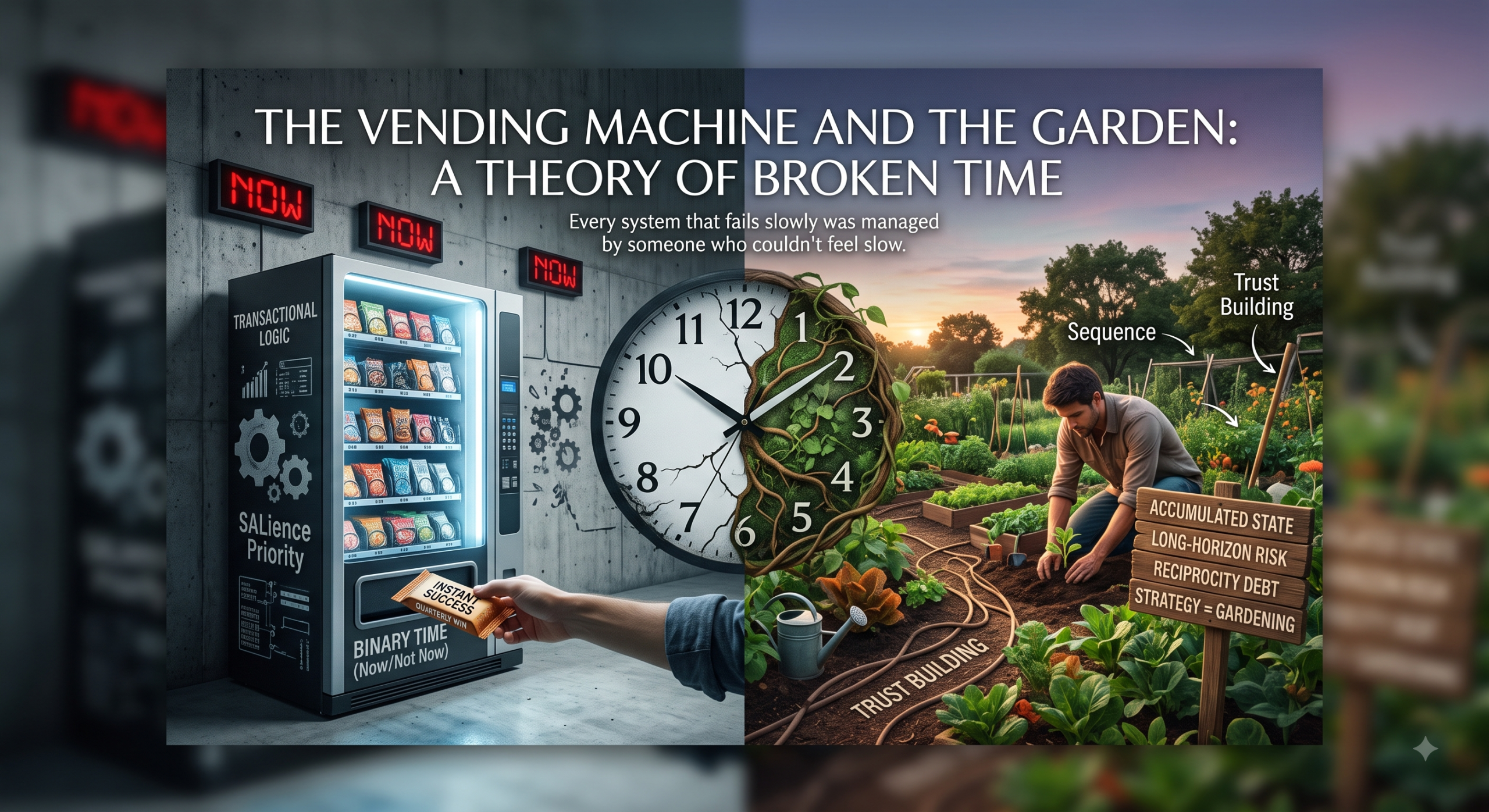
Every system that fails slowly was managed by someone who couldn’t feel slow.
This essay is about a perception flaw, not a character flaw. It shows up in individuals, in teams, and in entire companies, and wherever it appears it produces the same signature: brilliance under pressure, blindness to everything that compounds, and a strategy that treats the world like a vending machine when the world is actually a garden.
Time is binary, not continuous
For a healthy planning mind, the future has depth. Next week feels closer than next quarter, and both feel real enough to act on. Consequences cast a shadow backward, and that shadow is what we call motivation.
In the broken version, time collapses into two zones: now and not now. There is no gradient between them. Anything in “not now” carries near-zero weight, whether it sits three days away or three years away. Then, at some threshold, an item crosses into “now” and instantly acquires maximum urgency. Nothing exists until it is on fire.
This is the root distortion. Everything else in this essay is downstream of it.
Salience replaces priority
If the future generates no felt pressure, then “this matters” cannot trigger action. Something else has to, and that something is vividness: urgency, novelty, threat, interest. Attention gets allocated by salience, not by consequence.
This produces a familiar paradox. The same actor capable of genius-level output on a problem that grabs them will let a trivial maintenance task rot for months. Observers read this as laziness or selective effort. It is neither. Priority, as a concept, requires a working model of the future. Without one, salience is the only sorting function left.
Risk goes blind on exactly one axis
Risk is fundamentally a time computation: probability, times consequence, discounted by when it lands. Break the “when” dimension and you get a very specific distortion. Immediate risks register normally, sometimes excessively. Slow, compounding risks register as zero.
So the same actor looks reckless and cautious at once, depending on which horizon you check. Agonizing over today’s decision while ignoring the erosion that has been accruing for a year: the unmaintained relationship, the deferred renewal, the skill that stopped being sharpened, the trust that is quietly draining from an institution. This is not bravery and it is not stupidity. It is blindness to one category of danger: the kind that accrues invisibly and lands all at once.
The environment compensates, then calcifies
Systems route around damage. When one node cannot hold time, a neighboring node starts holding it for them. Tracking the dates. Pre-staging the work. Extending buffers quietly. Catching the drops before they hit the floor.
This stabilizes output, which is why it happens. But it does two corrosive things. It removes the feedback that would make consequences felt, so the pattern never self-corrects. And it teaches the broken node that items in “not now” reliably resolve themselves, which, from where it sits, is empirically true. Someone has become load-bearing infrastructure, and like most infrastructure, they are invisible until they fail.
Transactional logic: what strategy compiles to inside a short horizon
Now the core of it. What does strategy look like when the planning horizon equals the salience window?
It looks like a vending machine. Every goal gets mentally compressed into a single exchange: input action, immediate output. Need a resource, request it, receive it. Need an ally, ask, obtain. Need an outcome, act, collect.
This is not a belief anyone chose. It is what any strategy compiles down to when the future is unavailable as a workspace. Give any intelligent actor a two-week felt horizon and they will independently reinvent transactional logic, because it is the only logic that fits in the container.
Four things get deleted in the compression.
State. Transactional logic assumes the counterparty is stateless: no memory, no prior impression, no history conditioning the response. In reality, the answer to your request was mostly determined before you made it, by everything that accumulated or failed to accumulate beforehand. The transactional actor prices the ask at the moment of asking. The world priced it long before.
Sequence. Real outcomes are pipelines: exposure, trust, evaluation, commitment. Transactional logic sees only the final step and mistakes it for the whole process. This is why its effort estimates are always wrong by roughly the length of the invisible pipeline. The plan is not “skip the groundwork.” It is a plan in which groundwork was never a line item, because it never appeared in the mind.
Reciprocity debt. Every durable relationship, personal, commercial, institutional, runs on a ledger of given-before-asked. The transactional actor only ever appears on the ask side of that ledger, and is then genuinely confused by the cold response. From the other side, the pattern is legible in seconds: this one only shows up needing something. That reputation compounds negatively, in exactly the time zone the actor cannot perceive.
Failure signal. A real vending machine fails loudly and immediately, so you learn. Accumulated-state outcomes fail silently and late: the door that never opens, the terms that are quietly worse, the polite deferral that means never. The actor never sees the counterfactual, so the model never updates. Transactional logic is self-sealing.
The scaling law: it works in inverse proportion to stakes
Here is the trap. Transactional logic sometimes works. Small asks, hot conditions, personal charm: pure transactions can carry all of it. Each win confirms the model.
But there is a scaling law hiding in plain sight. The larger the outcome, the more it is determined by accumulated state rather than by the quality of the ask itself. Small outcomes are transactions. Large outcomes are gardens, and the harvest was decided in the seasons when you needed nothing. So the transactional actor scales confidently on a model that fails precisely at the stakes where failure is unaffordable. The vending machine works right up until you need it most, which is the cruelest possible reliability curve.
This is not just a person. It is also a company.
Zoom out and the same architecture appears at organizational scale. A firm managed quarter to quarter runs binary time: this quarter is “now,” everything else is “not now.” R&D, maintenance, culture, trust, resilience, all compounding assets, all weightless in the reporting window. Salience replaces priority in the form of whatever metric is currently on fire. Risk goes blind on the slow axis: technical debt, brand erosion, regulatory drift, climate exposure. Some department quietly becomes the clock carrier, absorbing the gap between what the org rewards and what keeps it alive. And strategy degrades into transactional logic: campaigns instead of reputation, hiring sprees instead of talent pipelines, compliance sprints instead of governance.
The individual and the institution fail by the same mechanism. Only the clock speed differs.
The lever: import urgency, stop exporting time
You cannot repair a broken internal clock, in a person or in an org chart. Every intervention that assumes the future will start feeling real fails, because it asks a colorblind system to try harder at red.
What works is translation: converting far consequences into near ones. Hard external deadlines with short-term stakes attached. Not “we need to invest in what compounds,” a sentence with no coordinates in a binary time system, but concrete commitments with dates inside the salience window and consequences that land within days. Cadence is the prosthetic for a missing future: the weekly ship, the monthly update, the standing review. Rituals are how systems without time-feel simulate one.
And, hardest of all for whoever is holding the clock: letting some things actually break. Every cushioned consequence is a lesson deleted. The compensating node is doing the pattern’s maintenance for it.
The one-line version: a broken sense of time makes the future weightless, so urgency replaces importance, long-horizon risk goes unseen, strategy collapses into vending-machine transactions, and the system quietly reorganizes around whoever is willing to carry the clock.
If you are reading this and slowly realizing you are the clock carrier, in your team, your company, or your family: that is a choice, not a fate. Carry it explicitly, with a name and a budget, or put it down and let the alarm ring. What you should stop doing is carrying it silently, because silent infrastructure gets neither credit nor relief, and the pattern it protects never ends on its own.