The corporation is not a fact of nature. It is a technology — a coordination machine invented to solve a specific problem at a specific moment in history. And like every technology, it has a shape determined by the constraints of its era.
The problem is that the constraints changed and the shape didn’t.
A machine built for expensive coordination
In 1937, Ronald Coase asked a question so simple that nobody had bothered to answer it: if markets are so efficient, why do firms exist at all? Why doesn’t everyone just contract with everyone else?
His answer: because using the market is expensive. Finding the right person, negotiating terms, verifying work, enforcing trust — every transaction carries friction. At some point it becomes cheaper to stop transacting and start commanding. Hire the people. Put them in a building. Tell them what to do.
The entire architecture of the modern corporation falls out of that single insight. The hierarchy exists because information had to be aggregated somewhere. The middle manager exists because context had to be carried between layers by a human. The annual planning cycle exists because recalibrating a thousand-person machine is so costly you can only afford to do it once a year. The office, the org chart, the meeting — all of it is downstream of one premise: coordination is expensive, so centralize it.
That premise held for roughly a century. It no longer does. And the organizations built on it are now running an architecture whose founding assumption has quietly been deleted.
What follows is a way of seeing where any organization actually stands. Three forms. Three ages. Only one of them has a future.
The Forged organization
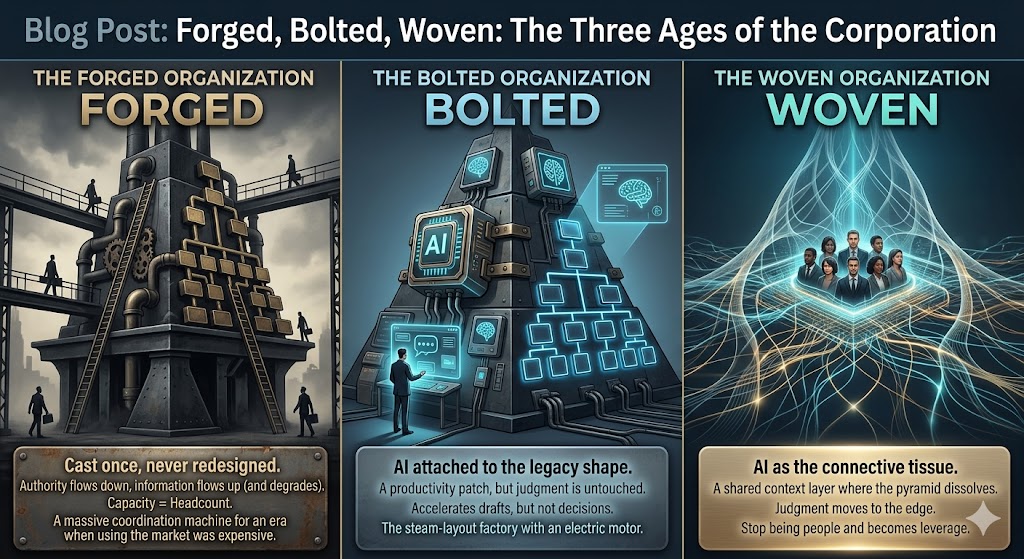
The first form was forged — cast once, in the industrial era, and essentially never redesigned.
Its lineage is older than most people are comfortable admitting. The first true multinationals were the colonial charter companies: shareholders, boards, dividends, hierarchies, and a core operating logic of extracting value at the periphery and concentrating it at the center. The modern corporation softened the methods and kept the architecture. Authority flows down. Information flows up, degrading at every layer. Capacity equals headcount: if you want ten times the output, you hire roughly ten times the people, and you accept that coordination overhead grows even faster than the payroll does.
The Forged organization is not stupid. It was the correct answer to its era’s constraints — the same way the steam-powered factory was the correct answer before electricity. Its problem is not moral. Its problem is that it is over-built: a massive apparatus for solving a coordination problem that is dissolving underneath it.
The Bolted organization
Then came the tools, and with them the second form — and the most dangerous one.
The Bolted organization is the legacy firm that attached AI to its existing shape. Copilot licenses for everyone. A chatbot in the support queue. “AI-powered” in the annual report. Each employee gets fifteen percent faster at their existing job, and the org chart does not move one box.
Here is why that fails, and why it was always going to fail: every previous technology wave — email, ERP, cloud, Slack — made communication cheaper but left judgment untouched. You still needed a human to read the message, make the call, hold the context. So the middle manager survived every wave, because the middle manager’s real function was never routing messages. It was aggregating context and exercising judgment at scale. No prior technology could touch that function. So the pyramid stayed.
AI bolted onto that pyramid produces a grim arithmetic: the same slow decision-making, now fed by ten times the volume of generated material. The bottleneck was never how fast the drafts got written. It was how fast the organization could decide. The Bolted organization accelerates everything except the thing that matters.
There is a historical rhyme here that should make every transformation officer sweat. When electricity arrived, factory owners did the obvious thing: they unbolted the steam engine and bolted an electric motor in its place. Gains were marginal. The factories that won were the ones that understood electricity wasn’t a better engine — it was a reason to redesign the entire floor plan. Small motors at every workstation. Single-story layouts. Workflow rebuilt around the new physics. That redesign took thirty years, and almost none of the incumbents survived it.
The Bolted organization is the steam-layout factory with an electric motor. It believes it has transformed. That belief is precisely what will kill it.
The Woven organization
The third form is only now becoming possible, and it is the first genuinely new corporate architecture in a century.
In the Woven organization, AI is not a tool that people use. It is the connective tissue the company is built around — the substrate that every function reads from and writes to. Not copilots at the edges. A shared context layer at the center.
This matters because AI is the first technology in history that attacks the load-bearing functions of hierarchy directly:
Context-holding. The deepest reason firms need departments, handoffs, and endless meetings is that no single human can hold the full state of the company. A woven intelligence layer can. When anyone can query the entire organizational context on demand, the information-routing function of management — the thing the pyramid was built to do — simply evaporates.
Judgment at the edge. Organizations centralize decisions because junior people lack context and senior people lack time. Give junior people senior-level context on demand, and decisions can finally move to where the information lives. Every management theorist since the 1960s said this was the ideal. None of them had a mechanism. Now there is one.
The coordination tax goes to zero. Search, contracting, verification, synthesis, institutional memory — Coase’s transaction costs, the very friction that justified the firm’s existence — are exactly what this technology compresses. The boundary of the firm shrinks to what genuinely requires tight human coupling: judgment, taste, relationships, accountability.
Output decouples from headcount. A ten-person woven company operates with the capability surface of a two-hundred-person forged one — legal, finance, research, analysis, content, support — without the quadratic coordination overhead that two hundred people generate. Capacity stops being a function of people and becomes a function of leverage.
What remains for humans is, fittingly, everything that cannot compress: deciding, owning the consequences, building trust, carrying responsibility. In the Woven organization the scarce resource is no longer capital and no longer labor. It is judgment-holders — the small number of people who can be trusted to decide, and who are accountable when they do.
The matrix
Put the three forms side by side and the pattern is hard to unsee:
| Dimension | Forged (industrial era, cast once) | Bolted (AI attached, shape unchanged) | Woven (AI as connective tissue) |
|---|---|---|---|
| Where AI sits | Nowhere. Coordination runs on humans, paper, meetings. | At the edges. Copilots per person, per tool. A productivity patch. | In the substrate. A shared context layer every function reads from and writes to. |
| What AI replaces | — | Tasks: drafting, summarizing, searching. Same jobs, 15% faster. | Coordination itself: routing, context transfer, synthesis, institutional memory. |
| Org shape | Pyramid. Authority down, filtered information up. | Pyramid with tools. Same chart, faster email. | A small human core of judgment-holders around a shared intelligence layer. |
| Middle management | The information router. Load-bearing. | Still routing — now drowning in AI-generated volume. | Routing absorbed by the layer. Humans set context, hold accountability, unblock. |
| Headcount logic | Capacity = people. 10x output needs ~10x heads. | Capacity = people × a modest multiplier. Hiring is still the default response. | Capacity = leverage. Output decoupled from headcount. Hiring is the last resort. |
| Institutional memory | In heads and filing cabinets. Leaves when people leave. | In scattered SaaS silos nobody searches. | In the layer: queryable, compounding, survives any departure. |
| Who has context | Seniority = context. Juniors execute blind. | The same gradient, slightly flattened by search. | Everyone, on demand. A junior can query the full state of the company. Decisions move to the edge. |
| Cost structure | Heavy fixed: payroll, offices, an overhead pyramid. | The same fixed base, plus tool spend on top. | Structurally lighter. The coordination tax approaches zero. A margin profile incumbents cannot match. |
| Cycle time | Quarters. Reorgs as the adaptation mechanism. | Months. Faster execution of the same slow decisions. | Days. Strategy, build, and learn loops compress together. |
| Scarce resource | Capital, then labor. | Talent willing to tolerate the bureaucracy. | Judgment and accountability — the humans who can be trusted to decide. |
| Fate | Protected only where physical capital is the moat. | The dangerous middle: legacy costs, marginal gains. Most enterprises today. | Out-competes on unit economics and speed. Doesn’t need to win the argument — it wins the market. |
Notice which column is the villain. Not the Forged organization — it at least knows what it is. The Bolted organization is the trap, because it has purchased the feeling of transformation at exactly the price required to avoid the real thing.
Why this shift is inevitable rather than aspirational
Every previous argument for reinventing the corporation was a moral argument, or a cultural one. Flatter hierarchies, empowered teams, stakeholder capitalism — appeals to values, easily deferred, endlessly co-opted into HR slideware.
This one is different in kind. The Woven organization does not need anyone to agree with it. Its cost structure is structurally lower and its cycle time structurally faster. It wins on unit economics, the same way the forged factory out-competed the artisan workshop in 1900 — not by being righteous, but by being cheaper and faster at scale. The old form won’t be out-argued. It will be out-competed.
The honest caveats, because a framework without its failure modes is marketing:
- Accountability does not compress. Someone must remain legally and morally on the hook. The woven form doesn’t eliminate humans; it concentrates everything on the humans who carry responsibility.
- Trust does not compress. Enterprise sales, partnerships, capital — still relationship-bound, still human-speed.
- Physical capital still rules where it rules. Ten woven people do not build a semiconductor fab. This shift eats the coordination-bound economy first, the capital-bound economy much later.
- Incumbents have a window. They own distribution, data, and regulatory relationships. The electricity transition took thirty years. This one will be faster, but it will not take a quarter.
The diagnostic
The usefulness of a framework is whether it produces a question that cuts. This one does, and it fits in five words:
Is your AI bolted, or woven?
If removing the AI from your company tomorrow would make everyone somewhat slower but change nothing structural — it’s bolted. If removing it would make the organization incoherent, because it carries your memory, your context, and your coordination — it’s woven.
Most leaders will answer “woven” and be wrong. The tell is simple: look at the org chart. If it would be recognizable to a 1970s executive, the weaving hasn’t started. The floor plan is still steam.
We are in roughly year two of a thirty-year redesign. The factories that win it are being laid out now.