Everyone is counting seconds. The number that decides your future is the one that picks what you never asked to see.
A few months ago, the state of the art in AI video was five seconds. A flicker. A GIF with ambitions. You wrote a prompt, waited, and got something that fell apart the moment a hand crossed in front of a face or a car turned a corner. It was a toy, and everyone treated it as one.
This week, ByteDance announced Seedance 2.5: thirty seconds of video, rendered at native 4K, in a single pass, with the character’s face, the lighting, and the physics holding together from the first frame to the last. Thirty seconds is not a flicker. Thirty seconds is the length of a television commercial. It is a production standard, and the industry has been waiting at that wall for a year.
So the obvious story writes itself. Five seconds became thirty. Thirty becomes a minute. A minute becomes five, then ten, then — at the end of the curve everyone is already drawing in their heads — you type a paragraph and a feature film comes out the other side. One prompt. One movie. The crew, the camera, the editing suite, all collapsed into a text box.
This is the wrong curve. The length number is a decoy, and the people building these systems already know it, which is why the most important thing in the Seedance announcement was not the thirty seconds. It was everything they shipped around the thirty seconds.
Let me show you what they actually told you, and then let me show you what it means.
The shot is the atom
Here is the question almost nobody asks, because the hype is too loud to hear it over: does longer even make sense?
Think about what you are actually asking for when you ask for ten minutes of video from one prompt. You are asking to specify ten minutes of the world — every cut, every glance, every line of dialogue, every change of light, the precise moment the character turns and the precise way she turns — in a block of text you typed before any of it existed. You cannot do this. Nobody can do this. The prompt for ten coherent minutes is not a paragraph; it is a screenplay, a shot list, a shooting schedule, and a director’s entire interior life, and you would have to get all of it right in advance, with no ability to see what you were making until it was already made.
And then suppose one thing is wrong. The wrong actor delivers the wrong look at minute six. In a ten-minute single-pass system, you have only one move: regenerate. Roll the dice again on all ten minutes and pray the part you liked survives. This is not editing. This is gambling with a render farm.
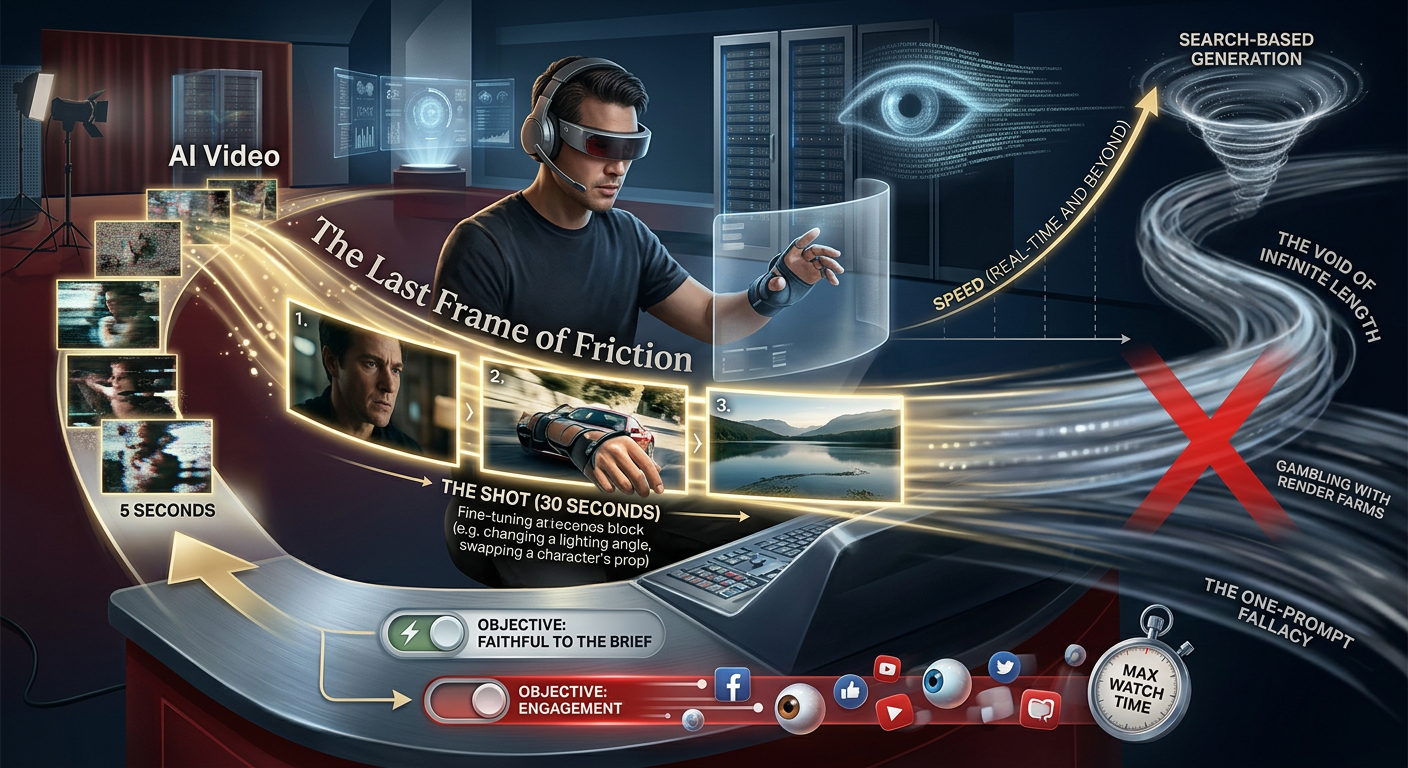
This is why your instinct is the correct one, and worth saying plainly: we are not heading toward the one-prompt feature film. We are heading toward the shot — the few seconds to half-minute of continuous footage that has been the atomic unit of film for a hundred years. Cinema was never made in single takes. It is assembled from shots, because the shot is the largest piece a human can actually hold in their head and control. Thirty seconds is not a way station on the road to ten minutes. Thirty seconds is roughly where the unit wants to sit, because that is the size of a thing a director can direct.
Now look again at what Seedance shipped, and watch the industry confess where it is really going. It did not just extend the clip. It added the ability to swap a single element inside a finished shot — change the product, change the background, replace a character — without regenerating the rest. It accepts up to fifty reference assets in one request: photographs, clips, audio, 3D models. In the demo, they fed it images of more than ten characters and let the model handle the casting and the choreography itself.
Read that as what it is. They are not building a longer dice roll. They are building an editing room. Non-destructive correction, asset-driven direction, controllable elements inside a stable frame. Every one of those features exists to solve the problem that length creates: the more you generate in one block, the more catastrophic it is to fix. The whole frontier is quietly admitting that the future is not one long generation. It is many short, controllable, correctable ones, stitched together.
The length number plateaus. Not because the models can’t go longer — they will — but because longer stops being the thing anyone wants. The shot is the atom. Lock that in, because it changes what the real exponential is.
The real exponential is speed — and it ends somewhere strange
If length isn’t the curve, what is? Speed. And speed has a destination that almost nobody has thought through to the end.
Right now, generating a high-quality shot takes minutes. The interesting line is not “minute-long video.” The interesting line is the moment generation crosses real time — when rendering thirty seconds of finished footage takes less than thirty seconds. And then the moment after that, which matters far more: when it takes one second. When the render outruns the eye.
Ask the question your gut already asked: what is the ultimate speed? It is not infinite — it’s bounded by silicon and memory bandwidth like everything else. But the meaningful ceiling isn’t a hardware limit. It’s a human one. It is the point at which the system can produce footage faster than any person can watch it.
Because once you are past that line, something inverts. Up to that point, more speed just means less waiting — a convenience. Past that point, more speed stops buying you time and starts buying you attempts. If you can render a shot in a second, you don’t render one shot. You render a hundred, and you keep the best. Generation stops being production and becomes search. You are no longer making a video. You are searching a space of all possible videos for the one that scores highest against some target.
And this is the precise moment the human falls out of the loop — not because anyone pushed them out, but because they physically cannot keep up. You cannot watch a hundred candidate shots per second and pick the winner. Something else has to watch. Something else has to judge.
That something is the agent you already imagined.
What “producing content” becomes
Here is what production looks like on the other side of that line, and it is exactly the structure your instinct sketched — a narrative agent sitting on top, running a loop.
A brief comes in. Not a prompt — a brief. A two-minute spot for a watch, nocturnal, melancholy, ends on the dial. The agent decomposes it the way a director and a writer would: into a sequence of shots. A shot list. Forty beats, each one a few seconds, each one a small, controllable, correctable atom. This is what replaces the impossible ten-minute prompt — not a longer paragraph, but a structured plan of short generations, which is a thing a machine can reason about and revise.
Then, for each shot, it generates. Not once — many times, because generation is now cheap and fast and the marginal candidate costs almost nothing. And here is the part that closes the loop: a second model watches the output. A critic. It checks the things a human supervisor checks on set and in the dailies room. Does the character’s face match the reference across all forty shots? Does the light stay consistent when we cut? Did the physics break? Does the brief actually land — is this melancholy, or did it come out merely dark? The critic scores each candidate, keeps what passes, kills what doesn’t, and sends the failures back to be generated again with adjusted instructions.
Generate, watch, judge, regenerate, assemble. A feedback loop with no human inside it. The director, the cinematographer, the continuity supervisor, the editor, and the entire dailies-review room — collapsed into a loop that runs faster than any of them could blink. The human, if there is one, sits above the loop, writing briefs and approving final cuts. They have been promoted out of production and into procurement.
This is genuinely, undeniably powerful. A small team — one person — can produce what once took a studio. That is real, and I am not here to mourn it. The crew was never the point of the crew. The point was the film.
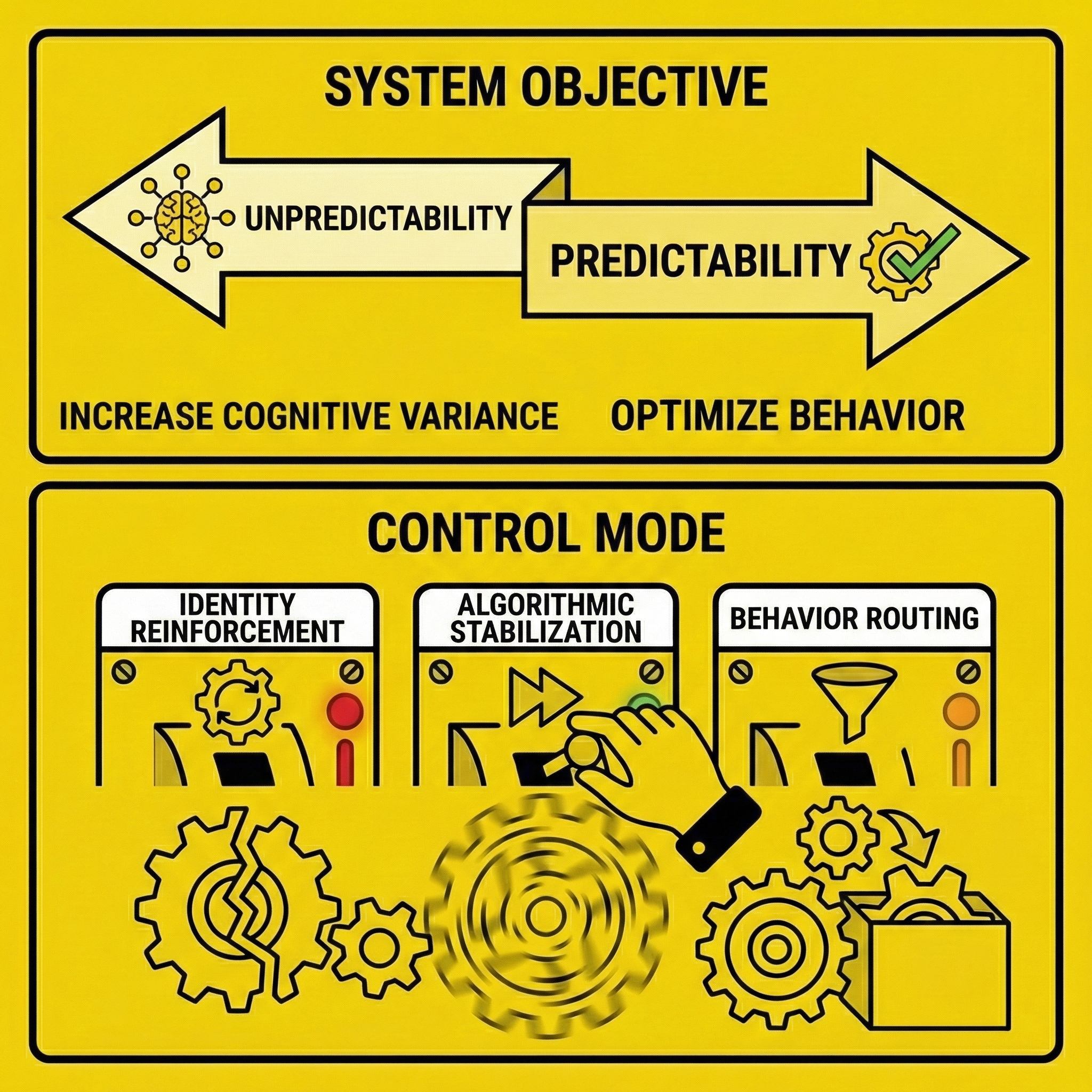
But notice what the loop is actually optimizing, because that is the whole game. The critic keeps the candidate that scores highest against an objective. In the demo, the objective is matches the brief. Innocent. Useful. A quality-control function.
Now watch what happens when you change one thing about the objective. Just one.
The objective is the entire story
The narrative agent doesn’t care what its objective function is. It will optimize whatever you point it at with equal, tireless indifference. Point it at “faithful to the brief” and you get an efficient studio. Point it at something else and you get something else.
Point it at engagement.
Here is the end state, and it is not science fiction — every component already exists or is one announcement away. The loop is the same: decompose, generate many, judge, keep the best, assemble. But the critic is no longer scoring against a creative brief. It is scoring against you. It has your watch-time. It has the exact second your eyes drifted last time. It knows which face shape, which pacing, which emotional register, which color of light makes you stay half a second longer. And generation is now fast enough — faster than you can watch — that it can mint a hundred versions of the next shot and serve you the one its model of you predicts you cannot look away from.
This is not the recommendation engine you know. The recommendation engine picks from a finite shelf — a library of things that already exist, made by people, at cost. It can only point you at what’s there. What I am describing has no shelf. It generates the thing, on demand, tuned to your specific flinch, and the library is infinite because the library is created in the act of showing it to you. Not “here is a video we think you’ll like.” Here is a video that did not exist one second ago, built in the gap between your last glance and your next one, shaped by a model whose only goal is that you do not leave.
You imagined the feedback loop as a tool for making good films. It is. It is also the most precise instrument for capturing attention that has ever been built, and the two are the same machine. The only difference is the objective function — one line of configuration — and one of those configurations is worth more money than the other. You already know which one the market will choose. The market always chooses the meter.
What got removed
For two decades, the scarcest thing in the economy has been attention. Everyone competing for it, nobody able to manufacture more of it. And the one thing that quietly protected your attention — the last bit of friction in the whole system — was that making the things aimed at you cost something.
A video took a crew, a budget, a week. That cost was a tax on the people trying to capture you. It limited how much could be made, how fast it could be tuned, how precisely it could be aimed. Bad content was expensive to produce, so there was a ceiling on how much of it could be thrown at any one person. The friction of production was the seawall. It was never love that protected you from the feed. It was cost.
That is the frame everyone is missing while they count the seconds. The story of AI video is not that clips are getting longer. Clips will settle at the length of a shot, because the shot is the atom and a hundred years of cinema already proved it. The story is that the cost of generation is going to zero, the speed is going past the eye, and a tireless agent is going to sit on top of the loop optimizing for whatever it is told to optimize for. Length was a decoy. The real number is the cost of the marginal video, and it is collapsing toward nothing, and when it hits nothing, the seawall is gone.
Generation getting cheap does not liberate your attention. It removes the last thing standing between your attention and the people who price it. The crew you were so eager to make obsolete was also, accidentally, the brake.
So watch the right number. Not thirty seconds. Not a minute. Not the imaginary one-prompt feature film that is never coming. Watch the cost of the next frame, and watch what objective the loop above it is quietly being handed. Because the moment that frame costs nothing and that objective reads engagement, you are not the director anymore.
You are the brief.
Evolve. Adapt. Dominate. — or be the thing the loop is optimizing against.