Goliath never threw a stone. He didn’t have to. An anatomy of the Situational Awareness kill.
I. The kill
On Thursday 30 July 2026, a twenty-five-year-old handed over a sixteen-billion-dollar equity book in under thirty-six hours because three banks told him to.
That is the whole event. Everything else is commentary.
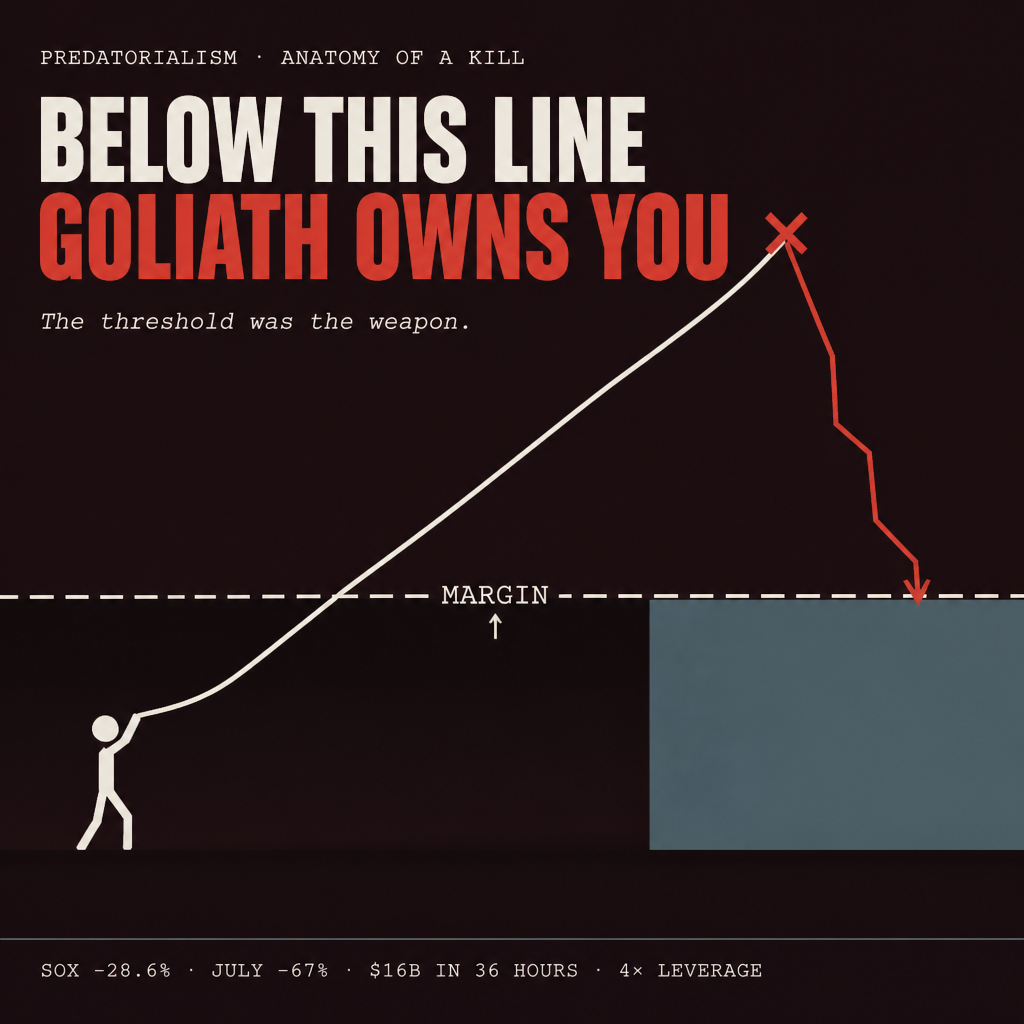
The numbers, for the record. Situational Awareness ran long AI infrastructure — SK Hynix, CoreWeave, Nebius, Micron, SanDisk, Bloom Energy — against short positions in software. Leverage as high as 400%. Through the end of June the fund was up roughly 439% after fees. Then the Philadelphia Semiconductor Index fell 28.6% from its 22 June peak, the individual longs fell 35–47%, and the software shorts went the wrong way at the same time. July: down 67%.
At four times leverage, a 25% move against you erases your entire equity. The market delivered 28.6%.
Prime brokers Bank of America, Goldman Sachs and JPMorgan worked the margin calls. Citadel bought the book at a discount reported above 10%, beating Millennium and Jane Street for it. The stocks ripped the same session — Nebius +26%, CoreWeave +22% — because the largest forced seller in the market had been removed from it.
He was not eaten. He was harvested.
II. Prey signature
Predation is not personal. It is a response to a signature. Something in the water reads as takeable, and the tank reorganises around it.
His signature was legible from a distance:
He filed. His positions were public. Followers tracked his quarterly filings for stock ideas. A 13F is a menu.
He was crowded. A Bank of America survey in July found 82% of respondents naming long global semiconductors the most crowded trade on earth. He was not early. He was the loudest passenger on a full boat.
He was famous. The 165-page essay that built the fund also built the map to it. Everyone knew the thesis, therefore everyone knew the positions, therefore everyone knew the pain threshold.
He was levered, and everyone knew the number. Once the market knows both your book and your multiple, your liquidation price is not a secret. It is arithmetic. Anyone with a spreadsheet could compute the level at which you stop being a market participant and start being inventory.
Four legible facts. Together they do not describe a genius. They describe a location.
III. The scavenger is not the killer
Here is where most of the commentary goes wrong, including his own.
In his letter to investors, Aschenbrenner partly blamed short sellers for accelerating the collapse and compared what happened to a bank run. He also said he took full responsibility. Both things can’t be the load-bearing sentence, and the market noticed which one he reached for first.
Griffin did not hunt him. Consider the evidence:
There was an auction. Citadel beat Millennium and Jane Street. A coordinated takeout does not run a competitive process against two firms that could outbid it.
The scale is impossible. To force the margin call you would need to move a three-trillion-dollar asset class. Nobody has that balance sheet. Citadel manages tens of billions. The sector moved 28.6% and the leverage did the rest — the position was structurally dead at 25%.
The trade wasn’t free. The Archegos basket is the counterexample nobody quotes: Bill Hwang held over 10% of names like ViacomCBS and Discovery, versus Situational’s 2–3% stakes. The more concentrated liquidation should have been the better bounce. Instead most of that basket kept falling for months, which suggests the leveraged buying had been holding those prices up in the first place. Buying a fire sale is not a guaranteed win. It is a bid nobody else wants to make, priced accordingly.
A discount above 10% on sixteen billion dollars is not the reward for cunning. It is the price of being the only participant still solvent enough to transact on a Thursday.
The predator’s edge is almost never intelligence. It is permanence.
Citadel may agree with the entire AI thesis. That is not the point. Citadel is built to still exist after a 30% drawdown, and a 4× book is not. One party bought optionality on time. The other sold it, for yield, at the top.
IV. Read the bounce correctly
The stocks came back immediately. People saw that and reached for conspiracy.
Read it the other way. A same-day, 26% rebound on the news of a completed forced sale tells you the decline was a liquidity event, not a fundamental one. A known seller who must transact is a ceiling on every name he owns. Remove the ceiling and price normalises. That happens whether he was hunted or simply overextended.
The bounce is consistent with both stories. It proves neither. Anyone presenting it as evidence of a plot is telling you they don’t understand what a forced seller does to a book.
And a liquidation ending is not the same event as a bottom.
V. The sling
David is the wrong metaphor, and that is exactly why it’s the right image for this.
David won. He won because he brought a weapon the giant could not answer, and because the sling was in his hand.
Aschenbrenner brought the same weapon and pointed it at himself. Leverage is a sling: it converts a small stone into a lethal one by spinning it faster, and the faster it spins, the harder it pulls on the person holding the rope. The multiple that produced 439% is the identical mechanism that produced −67%. It was never two instruments. It was one, and he had it around his own neck.
Which is why the story’s real violence happened before July. It happened on the day he chose the multiple.
You do not get ambushed in a tank you built. You get invoiced.
VI. Where predation would actually live
None of this makes the tank clean. It makes the suspicion misdirected.
The asymmetry worth investigating is not Griffin. It is the information chain. At least three institutions knew the exact positions, the exact leverage, and the exact price levels at which forced selling would begin — days before the market did.
Trading against a distressed counterparty you happen to know about is legal and ordinary. A prime broker leaking or trading ahead of a client’s forced liquidation is neither. That is a narrow, falsifiable question with a paper trail, and it is worth more than a thousand posts about who “controls the market.”
Aim your paranoia. Unaimed paranoia is just noise, and noise is what the tank feeds on.
VII. The ledger
He is not dead. Strip the drama and look at the position: still up roughly 80% on the year after the worst month of his life, leverage fully removed, the private book intact including the Anthropic stake he refused to dump for $3.5bn under duress on the Thursday morning. That refusal is the single most competent act in the entire episode. It is the one moment he behaved like a predator rather than a position.
He is twenty-five. Most people pay this tuition at forty-five, with less left over.
The lesson is not that sharks beat clever children. It is narrower and colder than that:
Being right is worthless if your financing has a shorter horizon than your thesis.
He was probably right about AI. He was liquidated anyway. Those two facts have nothing to do with each other, and the day you understand why is the day you stop being food.
House note
All figures reported by CNBC, Bloomberg, the Wall Street Journal, Reuters and Business Insider between 30 July and 2 August 2026. No quotations here are invented; the investor-letter language is as reported by outlets that reviewed it. Situational Awareness’s Anthropic position is disclosed for the reader’s own weighting.
Sources: CNBC on the forced unwind · CNBC on why it imploded · Bloomberg on the $10bn mark · Seeking Alpha on the averted selloff · Benzinga on the Archegos comparison