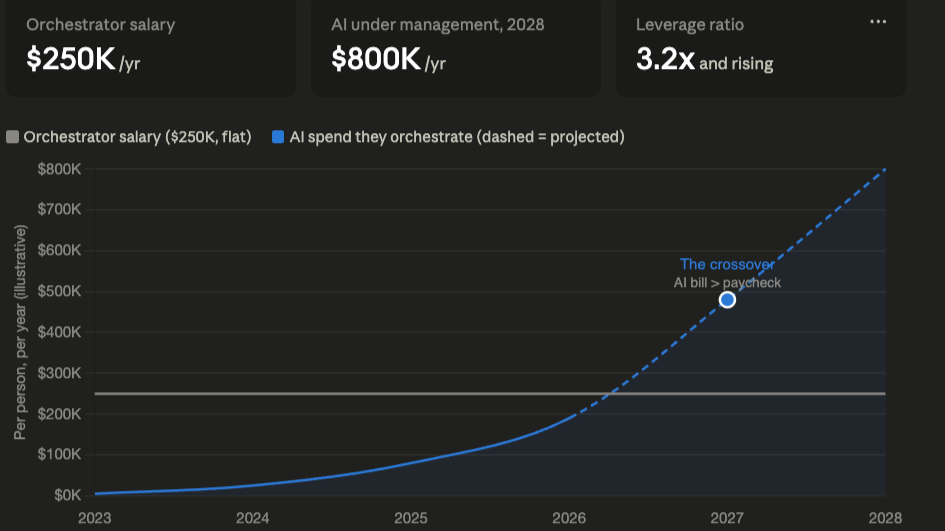
There is a moment coming for most knowledge workers, and for some it has already happened: the month when the AI bill they generate exceeds their paycheck.
Nobody plans for this moment. It arrives quietly, inside a finance dashboard, as a line item that grew 15% month over month while salaries grew 3% a year. And when it arrives, it changes what the person is. They stop being a cost that produces work. They become something the industrial world has a century of experience pricing: a person who costs less than the leverage they direct.
Knowledge work is just the last industry to find out.
Every industry already did this
We talk about “salary as a fee on managed capital” as if it were a finance idea. It is not. It is the standard economics of every industry that ever industrialized. Finance just gave it the cleanest name.
Look at who already costs less than what they direct:
A pilot earns a fraction of a percent, per year, of the value of the aircraft they command, before counting the passengers and cargo. Nobody calls the pilot overpaid, and nobody calls them redundant because the autopilot flies most of the route. They are priced as the judgment layer on top of a quarter-billion dollars of automated machinery.
A crane operator moves more tonnage in a day than a hundred laborers could in a week. Their wage is not a payment for lifting. It is a fee for directing the lift without killing anyone.
A media buyer earning $90,000 routinely manages $10 million a year in ad spend. Their entire professional identity is the ratio: spend under management and return on it. Their salary was never the interesting number.
A modern farmer runs thousands of acres alone, sitting on top of half a million dollars of GPS-guided equipment. A century ago that acreage employed forty people. The farmer’s income did not fall to one-fortieth. It became a return on directed machinery.
A power plant control room operator, a ship’s captain, a procurement lead, a construction project manager: all of them are already paid as a small fee on a large pool of leverage, whether that pool is machinery, cargo, budget, or throughput. In every case the same transition happened. The leverage arrived, the human count fell, and the humans who remained were repriced against the pool they directed rather than the labor they performed.
Only one major category of work escaped this pattern: knowledge work. Analysts, marketers, lawyers, developers, consultants, operators. There was no machine to direct, so the person remained the leverage. Output was bounded by hours and attention, salary was a reasonable proxy for capacity, and the whole apparatus of corporate planning, headcount budgets, comp benchmarks, and productivity metrics grew up around that assumption.
That exception just ended.
The new AUM
An orchestrator, meaning anyone who directs AI systems to do real work rather than occasionally chatting with one, now sits on the same curve every pilot, farmer, and media buyer already lives on. Their salary line is flat. The compute they direct compounds.
Run the illustrative numbers. A senior operator earning $250,000 a year, directing agents, research pipelines, code generation, and content systems, can plausibly generate several hundred thousand dollars a year in AI spend within two or three budget cycles. At some point the lines cross. Past the crossover, the human is the smaller line item, exactly as the pilot is next to the aircraft and the farmer is next to the combine.
This is the new AUM: AI Under Management. The dollar value of compute, tokens, and agent-hours a person directs per year. Once you see it, the correct frame for their salary snaps into place. It is not a wage for labor performed. It is a management fee on leverage deployed, the same fee structure that already prices half the industrial economy.
And the ratios are still tiny. An orchestrator at 3x leverage, spend against salary, looks aggressive next to today’s norms and laughable next to the mature versions of the pattern. The pilot runs at 1,000x. The media buyer at 100x. Knowledge work is at the very beginning of its industrialization curve, which is precisely why the next few years reprice everything.
What this changes, in every industry at once
Reframes are cheap. This one earns its keep because it forces three practical shifts, and unlike previous industrializations that hit one sector at a time, this one hits legal, marketing, finance, software, consulting, compliance, and operations simultaneously.
1. Headcount stops being the planning unit
Every annual plan budgets people. “We need three more analysts.” But if one orchestrator with $400K of AI under management outproduces four analysts with none, the analyst count is noise. The real planning question becomes: how much compute do we intend to deploy, and who is qualified to direct it?
This is how a farm plans (acres and machinery, then the operator), how an airline plans (fleet, then crew), how a fund plans (capital, then allocators). It is about to be how a law firm, an agency, and a consultancy plan. Organizations that keep budgeting chairs will lose to organizations that budget compute and hire allocators.
2. Compensation detaches from titles
Comp today is benchmarked against title, seniority, and market, all of which assume roughly comparable leverage between people with the same label. That assumption is now false inside a single team. Two “senior managers” can differ by 10x in the AI leverage they direct, which means they differ by something close to 10x in the output they are responsible for.
The honest benchmark going forward is the one the industrialized professions already use: what pool does this person direct, and what return do they generate on it? The person whose fee percentage keeps falling while their pool keeps growing is the one you cannot afford to lose. The person with a large salary and near-zero AUM is holding a title from a labor market that is dissolving underneath them.
3. Accountability moves from effort to return
Here is the part most commentary on AI leverage skips. High spend is not high value. Anyone who has watched a bad media buyer torch an ad budget, or a bad operator wreck a machine, knows that leverage without accountability just accelerates the loss. There will be people burning $30,000 a month in tokens to produce output nobody needed, pointing at their AUM as if the number itself were the achievement.
It is not. The number is the responsibility.
In every mature version of this pattern, the pool is the denominator of the only metric that counts. Funds measure return on assets. Airlines measure incidents per flight hour. Farms measure yield per acre. The parallel metric for orchestrators is return on compute: what the spend produced, in revenue, pipeline, shipped product, or cost genuinely displaced, against what it cost.
This is why the fee framing is not flattery. Fees come with fiduciary duty. If your salary is a management fee, you owe a return, and the organization is entitled to measure it. A fund manager who loses money does not keep the assets. A pilot who cannot pass the check ride does not keep the aircraft. An orchestrator who cannot show a return on their compute should not keep the budget.
The objection worth taking seriously
The obvious pushback: if the AI does the work, why does the human directing it deserve a quarter million dollars?
Every industrialized profession already answered this. The aircraft flies itself most of the time; the pilot is paid for the minutes it must not be allowed to. The combine drives itself; the farmer is paid for knowing what to plant, when, and what the market will do to the price. Leverage does not allocate itself, and the gap between competent and incompetent direction is enormous, compounding, and entirely a function of judgment: what to point the leverage at, when to stop, what to distrust, what the output is actually worth.
Two people with identical tools and identical budgets will produce wildly different returns. The gap between them is the entire justification for paying either of them.
If anything, the fee framing makes the human more accountable, not less. A salary can hide inside overhead forever. A fee on a visible pool, with a measurable return attached, cannot.
What to do with this
If you run an organization, in any industry: start tracking AI under management per person, and return on that spend, this quarter. Not because the metric is perfect. It is not. But whatever you measure first becomes the language of every planning conversation after, and you want this language installed before your competitors have it.
If you are the person whose AI bill is approaching your paycheck: stop apologizing for the line item. Start reporting the return on it, unprompted, before anyone asks. In every industry that went through this transition, the people who volunteered accountability for their leverage were handed more of it. That is how capital, machinery, and budgets have always flowed, and compute is simply the newest pool.
The crossover is coming for your industry whether you name it or not. The pattern is a century old; only the pool is new. The new AUM is AI Under Management, your salary is the management fee, and the only question that follows is the one every owner of leverage eventually asks:
What is the return?