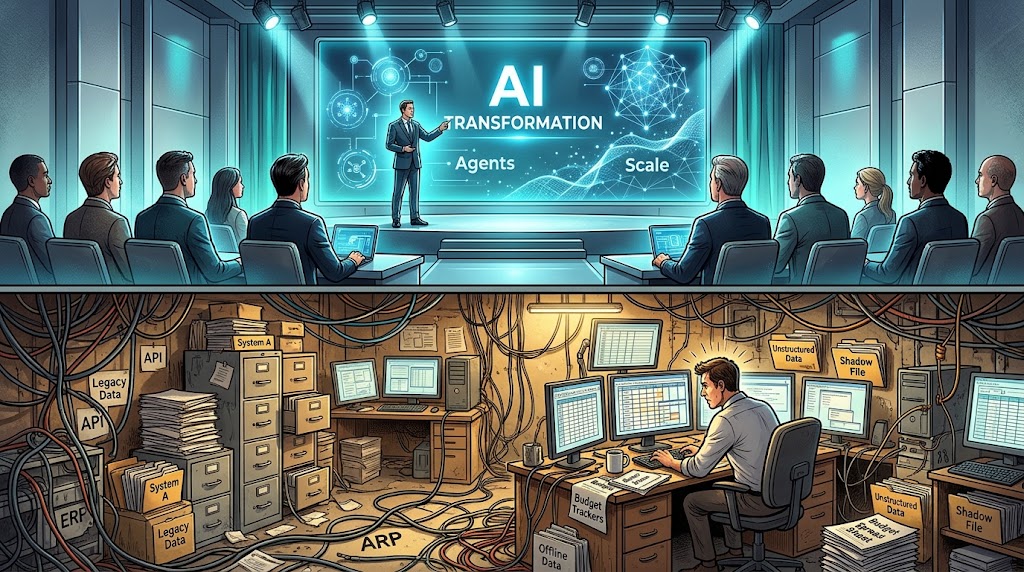
Enterprises will use AI. Just not the way it’s being sold on stage right now.
I had coffee with a friend recently. He runs a department at a large enterprise, the kind of company with a Chief AI Officer and an AI strategy deck. I asked him how they’re planning to use AI.
He laughed. “Buddy, I can’t even get a clear, simple number out of our systems on how much of my budget I’ve spent. I keep my own spreadsheet on the side so I don’t run over. And upstairs they’re talking about AI replacing all the work.”
Two different companies under one roof
That sentence describes two companies living in the same building.
In the boardroom, AI is a transformation story. Agents will run processes, headcount will shrink, productivity will jump.
On the floor, a department head can’t answer “how much have I spent?” without exporting data, cleaning it and keeping a shadow file. Nobody up there is lying. They’re just looking at the demo, not at the plumbing.
It’s not one spreadsheet. It’s thousands.
My friend’s budget tracker isn’t an exception. Every large organisation runs on thousands of these small workarounds:
- The same number living in three systems, each slightly different
- Approvals that happen in email threads, not in any tool
- A process that works because one person knows which file to check
- Master data nobody owns, so nobody fixes it
- Reports rebuilt by hand every month because the export breaks
AI doesn’t fix any of this by itself. Point an AI agent at messy, fragmented data and you get a faster, more confident version of the same mess.
So who actually builds all of this?
This is the question that rarely makes it into the keynote. Every “AI workflow” needs someone to:
- Map the process as it really runs, not as the org chart says
- Connect the systems and get access to the data
- Clean and own the data that feeds it
- Decide who approves what the AI does, and who is accountable when it’s wrong
- Maintain it when a system changes, a vendor updates an API or a team reorganises
In most enterprises, that lands on IT. The same IT department that already has a backlog of projects measured in quarters, a security team that has to sign off on every new tool, and procurement cycles longer than the AI model’s release cycle.
The bottleneck was never the model. It’s the organisation around it.
And then AI creates its own problems
Rolling AI out at scale doesn’t just inherit the old problems. It adds new ones:
- Shadow AI. Teams that can’t wait for IT start pasting company data into whatever tool is easiest. Now you have a governance problem on top of a data problem.
- Confident wrong answers. An AI summarising bad data doesn’t say “I’m not sure.” It gives you a clean, well-written number that happens to be wrong.
- Accountability gaps. When an agent approves an invoice or sends a client email, whose decision was it?
- New workarounds. People stop trusting the output and build yet another spreadsheet to check it. Back to square one.
Drafting emails is not AI enablement
Let’s be honest about where most enterprises are today. A licence for a chat assistant. People drafting emails faster, summarising meetings, generating an image for a slide.
That’s useful. It’s also not transformation. It makes individuals a bit quicker at tasks that sit around the real work, while the core processes, the ones that move money, materials and decisions, stay exactly as they were.
If my friend still can’t see his budget, the company hasn’t been AI-enabled. It has been AI-decorated.
What real enterprise AI will look like
AI in enterprises will be real, but it will look far less spectacular than the keynotes. I expect it to arrive like this:
- Data foundation first. One trusted system of record per domain, so there is a single number to ask about in the first place.
- Narrow, boring workflows. Budget tracking, invoice matching, supplier data collection, report preparation. Specific jobs with clear inputs, owners and checks.
- Built into the systems people already use, not bolted on as yet another chat window.
- Humans in the loop where it matters, with clear accountability for what the AI is allowed to decide.
- Domain platforms doing the heavy lifting, so IT isn’t building every workflow from scratch.
I see this every day in sustainability. Companies want AI to produce their emissions report, but the activity data sits in invoices, utility portals, ERP exports and supplier emails. The value isn’t the AI writing the report. It’s getting that data into one place you can trust, then letting AI do the work on top.
The question to ask on Monday
AI will change how enterprises work. But it will happen process by process, dataset by dataset, built by real teams with real budgets and real backlogs. It won’t happen through a press release.
So before the next AI strategy meeting, ask one simple question: can each of our managers see, today, how much of their budget they’ve spent?
If the answer is no, that’s where your AI strategy starts.
What’s the “budget spreadsheet” in your organisation? I’d like to hear the examples.